Reading the Room: How Elite Flankers Build a Tactical Intelligence System Without Rewinding a Single Play
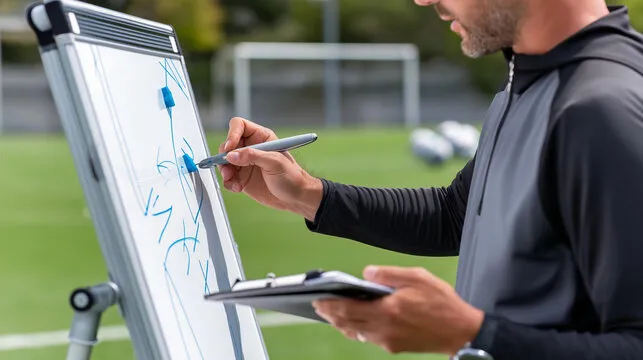
Photo: football player studying tactical playbook whiteboard strategy, via t4.ftcdn.net
There is a persistent myth in American football that the ability to read an offense before the snap is a gift—something a player either has or doesn't. Watch enough elite flankers work, however, and a different picture emerges. What looks like instinct from the stands is, upon closer examination, a highly developed recognition system: a structured mental library of formations, personnel groupings, route combinations, and blocking tendencies that the athlete has built through deliberate, repeated exposure and organized reflection.
Film study is typically the vehicle through which that library gets constructed. But the cognitive skill itself—the capacity to extract meaningful diagnostic signals from a pre-snap picture and convert them into a positioning advantage—can be developed through frameworks and habits that extend well beyond a film room. This piece examines how elite flankers build and apply that tactical intelligence, and how competitive athletes at any level can accelerate the same process.
The Foundation: Understanding What You're Actually Looking For
Most athletes who watch film do so passively. They observe plays unfold, register outcomes, and move on. Elite defenders approach the same footage as analysts: they are not watching what happened, they are cataloguing why it happened and identifying the pre-snap indicators that made the outcome predictable in retrospect.
For a flanker, the diagnostic hierarchy typically begins with personnel groupings. Before a single player lines up, the number of receivers, tight ends, and backs on the field communicates a meaningful range of probabilities. Eleven personnel—one back, one tight end, three receivers—signals a pass-heavy tendency in most offensive systems. Twenty-one personnel—two backs, one tight end—shifts the probability distribution toward run concepts and play-action. These are not certainties; they are probability weights that sharpen the flanker's anticipatory posture before the formation is even set.
Formation alignment builds the next layer. Where receivers are positioned relative to the offensive line, whether the tight end is attached or detached, the depth of the running back's alignment—each element narrows the play-call probability further. A receiver split wide with a compressed split in trips formation, for instance, frequently signals a route concept designed to create horizontal stress, which in turn informs where the ball is likely to go and which gaps in coverage are being targeted.
Building a Systematic Breakdown Protocol
The difference between a flanker who benefits from film study and one who maximizes it lies in the structure of the process. Improvised observation produces inconsistent takeaways. A systematic breakdown protocol produces a transferable mental model.
A reliable protocol for competitive flankers follows a consistent sequence:
Step 1 — Identify the personnel grouping. Before the play develops, note the offensive personnel on the field. Log this against the down and distance. Over a sufficient sample of plays, patterns will emerge: certain groups appear in certain situations with statistical regularity.
Step 2 — Catalog the formation. Map the alignment of skill players relative to the line of scrimmage and the hash marks. Note the strength of the formation—which side carries more personnel or structural weight—and track how the offense distributes formations across different field zones.
Step 3 — Identify pre-snap motion. Motion before the snap is among the most information-rich signals available. Jet motion across the formation frequently indicates a constraint play or a run concept designed to stress the perimeter. A receiver going in motion who draws a defensive back with him reveals man coverage; a motion that produces no corresponding defensive adjustment signals zone. Elite flankers treat motion as a diagnostic tool, not merely a cosmetic element of the offensive scheme.
Step 4 — Project the route concept. Based on the formation, personnel, and any motion, project the most probable route combinations before the ball is snapped. This is not guessing—it is probability-based anticipation built on accumulated pattern recognition. The more plays a flanker has processed through this protocol, the faster and more accurate the projection becomes.
Step 5 — Validate or revise after the snap. Track whether the projection matched the actual play development. When it doesn't, analyze the divergence: Was it an unusual formation use? A well-disguised constraint? A tendency broken deliberately? Each mismatch is a refinement opportunity that makes the model more precise.
Translating Observation Into Real-Time Field Intelligence
The practical value of this framework is only realized when the mental models built through systematic review translate into faster, more accurate decisions during live play. That translation requires a specific kind of practice.
The most effective bridge between film study and field application is pre-snap verbalization during practice. Before each rep in individual or team periods, the flanker should articulate—internally or aloud—the personnel grouping, the formation tendency, and their projected read. This forces active engagement with the diagnostic process rather than passive reactivity. Over time, the verbalization becomes compressed and automatic; the same cognitive work happens in fractions of a second during live reps.
Shadow recognition drills offer another valuable tool. Using game footage without the play developing—pausing immediately after the offense breaks the huddle and sets—the athlete practices generating a formation read and play projection in isolation, before outcome bias contaminates the analysis. This is the film equivalent of a batting cage: controlled repetition of a specific cognitive skill in a low-stakes environment.
Cross-referencing tendencies by down and distance is a further accelerant. An offense that runs a particular formation in second-and-long situations with high frequency has established a tendency that a prepared flanker can exploit. Building a simple personal tendency chart—even a handwritten one organized by down, distance, and field position—creates a portable reference that reinforces the mental model between sessions.
The Cognitive Habits That Separate Good from Great
Beyond the mechanics of film breakdown, elite flankers share a set of cognitive habits that compound their tactical advantage over time.
They study the offense, not just their assignment. A flanker who only reviews plays in which they are targeted or directly involved is leaving the majority of available information on the table. Understanding how an offense distributes the ball across its route combinations, and how the quarterback's eyes and progression habits reveal where the play is going, provides context that makes individual assignments more intelligible.
They study their own tendencies as rigorously as their opponents'. The flanker who recognizes that they consistently over-pursue in a particular formation, or that their alignment tip-offs their coverage responsibility, is in a position to correct those vulnerabilities. Self-analysis through film is not a humbling exercise—it is a competitive one.
They maintain curiosity about why, not just what. The most tactically sophisticated flankers are not satisfied with cataloguing outcomes. They want to understand the design logic of the offense: why a particular formation creates the spacing it does, why a specific motion sequence generates the conflict it generates. That conceptual depth produces a more flexible and durable recognition system than surface-level pattern memorization.
Pattern Recognition as a Trainable Skill
The central argument of this piece is also its most important one: tactical intelligence is not innate. It is built. The flankers who appear to possess preternatural anticipation have, in nearly every case, invested deliberate hours in the systematic study and structured repetition described above. The frameworks are learnable. The habits are adoptable. The competitive advantage they produce is available to any athlete willing to approach the cognitive dimension of the game with the same commitment they bring to the weight room.
For the competitive flanker serious about reaching the next level, the film room—or its functional equivalent—is not optional. It is where championships are decided before the opening whistle ever blows.