Diagnosing the Defense: Pre-Snap Recognition Skills Every Competitive Flanker Must Master
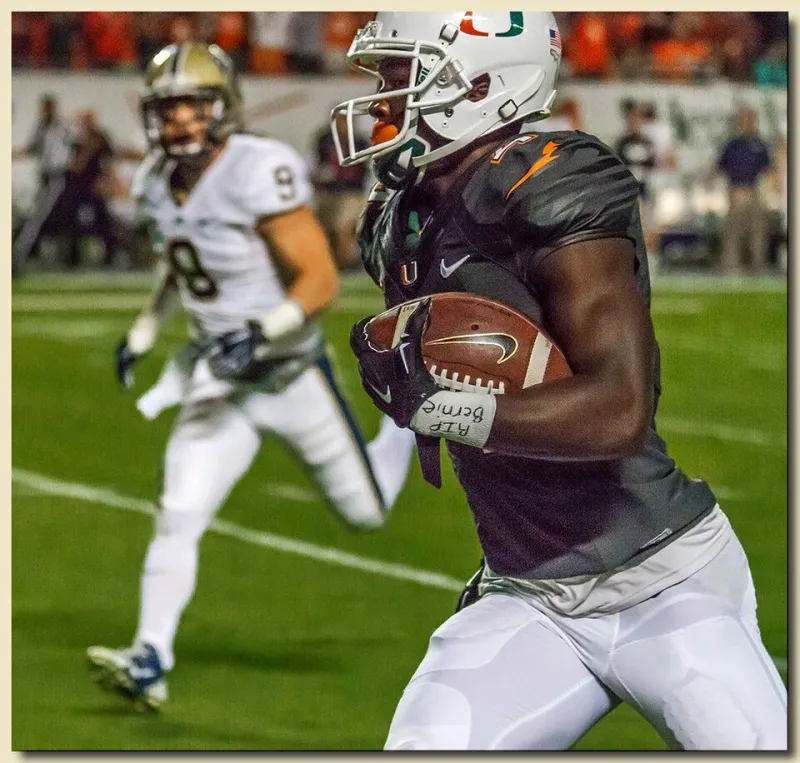
Photo: Allen Lubitz, CC BY 4.0, via Wikimedia Commons
The margin between a good receiver and a great one is rarely measured in speed or route precision alone. At the highest levels of competitive play, what separates elite flankers from their peers is the ability to process information quickly — to look at a defensive alignment and, within seconds, identify what coverage is being played, where the leverage is, and how to attack it. This is not instinct. It is a trained cognitive skill, and it can be developed systematically.
The Information Window: What Happens Before the Snap
From the moment a flanker approaches the line of scrimmage, the defense is communicating. Safeties rotating toward the box, cornerbacks pressing at the line, linebackers shading to one side — each of these movements carries information. The challenge is learning to read that information accurately and quickly under the pressure of live competition.
Elite athletes develop what coaches often call a "pre-snap checklist" — a structured sequence of observations made in the seconds between the huddle break and the snap count. A well-trained flanker will scan in a deliberate order: first identifying the depth and alignment of the cornerback across from him, then locating the near safety, then scanning the linebacker depth to determine whether the coverage is likely zone or man.
The cornerback's stance, in particular, is one of the most reliable indicators available. A corner pressed tight to the line with inside leverage typically signals man coverage, often with safety help over the top. A corner playing off with outside leverage frequently indicates zone — either Cover 2 or Cover 3 — where his responsibility is to protect a defined area rather than shadow a specific receiver. These are not absolute rules, but they are reliable starting points that give a flanker a working hypothesis before the ball is snapped.
Identifying Coverage Families: Zone Versus Man
For any flanker working to sharpen his game intelligence, the foundational skill is distinguishing between zone and man coverage families. From there, the reads become increasingly refined.
Man Coverage Indicators:
- Cornerback maintains consistent eye contact with the receiver pre-snap
- Defensive back mirrors the receiver's lateral movements during motion
- Safeties positioned deeper with inside leverage
- Linebackers aligned closer to potential receiving threats
Zone Coverage Indicators:
- Cornerback's eyes are directed toward the quarterback, not the receiver
- Defensive backs hold alignment despite receiver motion
- Safeties positioned at intermediate depth with balanced alignment
- Soft cushion from corners, indicating area responsibility
Understanding these families allows a flanker to make route adjustments that take advantage of coverage vulnerabilities. Against man coverage, route concepts that create separation through sharp breaks and leverage manipulation become most effective. Against zone, finding soft spots between defenders and settling into open windows becomes the priority.
The Role of Motion and Formation Shifts
One of the most underutilized tools for reading defense at the pre-snap level is motion. When a receiver or back goes in motion across the formation, the defensive response reveals a great deal about the coverage structure. If a defender follows the motion across the field, it confirms man coverage. If the defense rotates zone responsibilities to account for the shift, it confirms zone.
Competitive flankers at the collegiate and professional levels routinely use this information — gathered from their teammates' motions — to adjust their own route expectations before the play begins. Even when you are not the one going in motion, you are gathering data. Every shift in the defense is a clue.
Formation personnel groupings also factor into pre-snap reads. Defenses frequently tip their coverage intentions based on how they align to specific offensive formations. A heavy personnel grouping may draw a base defense with predictable coverage tendencies. An empty backfield formation often forces a defense to declare its structure more openly, giving experienced receivers a cleaner read.
Developing Recognition Through Deliberate Practice
The cognitive skills required for pre-snap diagnosis are not built through repetition alone — they are built through deliberate repetition with a specific focus on pattern recognition.
Film Study With Intentional Questioning Before reviewing any game film, establish a specific question to answer: "What coverage was the defense playing on third-and-medium situations in the second half?" Structured film sessions train the brain to filter relevant information efficiently, which translates directly to faster reads on the field.
The Freeze-Frame Drill During practice, request that your coaching staff pause a live or simulated play at the snap moment. From a frozen pre-snap image or moment, identify the coverage family, predict the post-snap movements of each defender, and verbalize your route adjustment. This drill builds the mental muscle of rapid diagnosis.
Competitive Recognition Reps In seven-on-seven or team practice settings, challenge yourself to verbalize your coverage read aloud immediately after each snap — not after the route is run, but during the stem of the route. This forces real-time processing rather than retroactive analysis.
Opponent Tendency Charting Develop the habit of charting opponent defensive tendencies before each game. Note down situations — down, distance, formation — in which specific coverages appear most frequently. This preparation builds a mental database that accelerates recognition when those situations arise in competition.
Translating Reads Into Route Adjustments
Knowledge of coverage is only valuable when it produces a corresponding adjustment in execution. The great flankers in American football history — from Jerry Rice to Larry Fitzgerald to Stefon Diggs — were not simply physically gifted. They possessed an exceptional ability to translate what they saw into what they did, often within fractions of a second.
A flanker who reads Cover 2 before the snap, for example, knows that the corner will likely sink into the flat and the safeties will split the deep halves. This creates an opportunity in the intermediate middle of the field — a dig or crossing route can find open space that simply does not exist against other coverage structures. That adjustment, made before the snap, is the difference between a contested catch and a clean reception with yards after contact.
Building a Smarter Athlete
At Flanker Training, we believe that elite athletic development is not confined to what happens in the weight room or on the practice field during physical reps. The mind is a trainable asset, and the athletes who commit to developing their cognitive game with the same rigor they apply to their physical conditioning are the ones who consistently perform when championships are on the line.
Pre-snap recognition is not a talent reserved for a select few. It is a skill set — one built through structured study, purposeful repetition, and a genuine commitment to understanding the game at a deeper level. Start with the fundamentals: learn to read the cornerback, locate the safeties, and identify the coverage family. From there, the reads become faster, the adjustments become more instinctive, and the game begins to slow down in the best possible way.