See the Field First: How Elite Flankers Develop the Spatial Intelligence That Defines Champions
In competitive rugby and football, the flanker position is among the most physically and intellectually demanding on the field. It demands an athlete who can transition from explosive short-burst acceleration to sustained aerobic output, all while processing a constantly shifting tactical picture. Yet for all the attention given to strength metrics and sprint times, the attribute that most consistently separates elite flankers from average ones is far harder to measure: spatial awareness.
Understanding where you are, where your opponents are moving, and where the ball is going before it gets there — that is the cognitive edge that defines the position. And increasingly, the most sophisticated athletic development programs in the country are treating that edge as something trainable, not innate.
The Biomechanics of Positional Play
Before examining the cognitive dimension, it is worth grounding the conversation in physical mechanics. Elite flankers operate in what biomechanists refer to as a "transitional movement state" — they are rarely stationary, rarely in full sprint, and almost always preparing for a change of direction. This places enormous demand on hip flexor flexibility, glute activation, and ankle dorsiflexion.
Strength and conditioning coaches working with Division I rugby programs across the United States have increasingly emphasized what is known as the "ready position" — a low, athletic stance that allows the athlete to react laterally, forward, or backward with equal efficiency. Maintaining this position across a full eighty-minute match requires not just strength, but a specific kind of postural endurance that traditional weight room programs often neglect.
According to coaches at several competitive collegiate programs, athletes who develop superior positional mechanics — specifically through single-leg stability work, hip rotation drills, and reactive agility training — demonstrate measurable improvements in their ability to close on ball carriers and disengage from contact. These are not abstract gains. They show up in game film.
Reading the Room: Cognitive Load on the Modern Flanker
The physical demands of the flanker position are well-documented. Less discussed, but equally critical, is the cognitive architecture required to perform at an elite level. Flankers must process multiple streams of information simultaneously: the position of the ball, the alignment of opposing forwards, the movement cues of the backline, and the tactical signals from their own team.
Sports psychologists working with high-performance programs describe this as "perceptual-cognitive skill" — the trained ability to extract relevant information from a complex visual environment and translate it into decisive action. Research in this area, much of it drawn from European rugby academies but increasingly applied in American collegiate and professional programs, suggests that this skill can be developed through deliberate practice.
One method gaining traction among elite US-based coaching staffs is "decision-training," a framework in which athletes are deliberately placed in situations with incomplete information and tight time constraints. Rather than running scripted plays to perfection, athletes are asked to read live defensive alignments and adjust in real time. The goal is not to build pattern recognition for a single scenario, but to develop the cognitive flexibility to respond to novel situations under pressure.
Pattern Recognition: Training the Eyes Before the Legs
One of the most compelling developments in flanker-specific athletic development is the integration of video-based perceptual training into weekly preparation cycles. Athletes review film not to memorize plays, but to identify movement cues — the subtle tells that precede a pass, a cut, or a defensive shift.
Coaches working with elite programs describe a progression model: athletes begin by watching film at reduced speed to identify key movement patterns, then gradually increase playback speed until they are processing footage in real time. Some programs have begun incorporating virtual reality environments that simulate live match scenarios, allowing athletes to rehearse decision-making without physical fatigue as a variable.
The objective is to compress the reaction window. When a flanker can recognize a developing play 0.3 seconds earlier than their opponent, that advantage compounds across dozens of possessions. It translates to more dominant defensive sets, more effective blitz timing, and more efficient support running on offense.
Translating Awareness Into Action: The Role of Reactive Agility Training
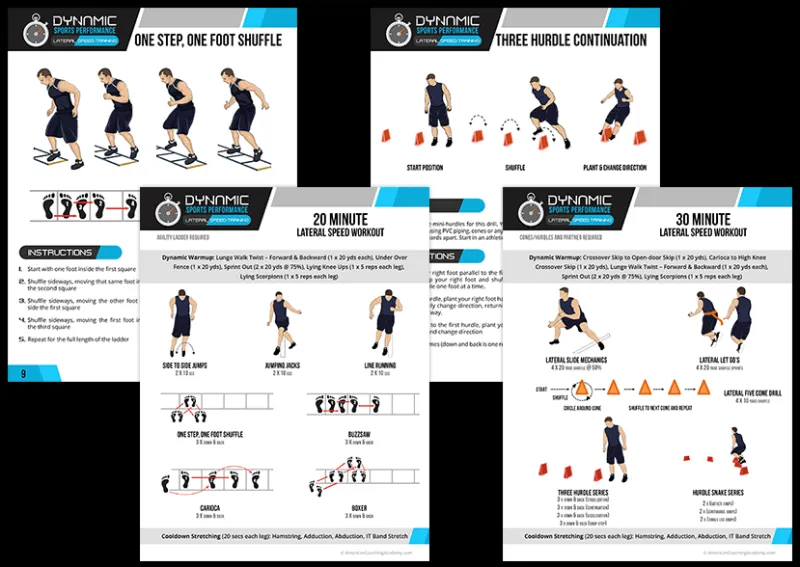
Knowledge of positioning is only valuable if the athlete can act on it. This is where reactive agility training bridges the gap between cognitive development and physical execution. Unlike traditional agility drills — ladder sequences, cone patterns, and predetermined cutting routes — reactive agility training introduces an external stimulus that the athlete must respond to in the moment.
Practical implementations include partner-mirroring drills, light-based reaction systems, and coach-directed live shadow drills. What these methods share is an emphasis on response latency: how quickly can the athlete process an external cue and produce the appropriate movement response?
For flankers specifically, the most effective reactive drills mirror the spatial demands of actual game situations. Multi-directional pursuit drills, where the athlete must close on a moving target from different approach angles, are particularly well-regarded among strength coaches at the collegiate level. These drills train not just quickness, but the ability to select the optimal movement path under time pressure — exactly the skill required in live match play.
Building the Complete Positional Athlete
The most progressive athletic development programs no longer treat the flanker as simply a fast, strong forward who can tackle. They treat the position as a distinct athletic archetype that requires a carefully integrated training model — one that develops physical capacity, movement efficiency, and cognitive processing in parallel.
For competitive athletes looking to elevate their game, the takeaway is clear: invest equally in the physical and the perceptual. Develop the strength and mobility to hold your ready position for the full duration of a match. Train your eyes as deliberately as you train your legs. And practice making decisions under pressure until the right choice becomes instinctive.
The flanker who arrives at the right place before the play develops does not get there by accident. They get there because they have trained to see the field — and to act on what they see — faster than anyone else on it.