Small Hands, Big Catches: The Biomechanical Case for Rethinking Receiver Prototyping

At every level of competitive football, the combine measurement tape has wielded enormous influence over how receivers are evaluated. Hand span, in particular, has functioned as a proxy for catching reliability — the assumption being that larger hands produce larger catch windows, and larger catch windows produce more completions. It is a logical framework on the surface. But it is one that biomechanical research is beginning to dismantle.
For flankers who have heard the critique — "your hands are too small" — the science offers not just reassurance, but a legitimate competitive framework. Understanding why smaller-handed receivers can outperform their larger-handed counterparts in contested situations is not merely academic. It is actionable intelligence that reshapes how athletes approach hand training, sensory development, and high-pressure catch mechanics.
The Assumption That Has Dominated Receiver Evaluation
The logic behind preferring larger hands in receivers mirrors the logic applied to other positions. Offensive linemen with longer reach are presumed to have blocking advantages. Quarterbacks with larger hands are presumed to grip the ball more securely in adverse weather. The extension of this thinking to receivers suggests that more surface area equals more ball contact, and more ball contact equals fewer drops.
What this framework misses is that catching a football — particularly under defensive pressure — is not primarily a surface area problem. It is a coordination and sensory processing problem. The question is not how much of the ball a receiver can cover with his hands. The question is how precisely and how quickly he can adjust grip force, finger positioning, and wrist mechanics in response to a ball arriving at an unexpected angle, speed, or spin rate.
Those are neurological and proprioceptive challenges. And on those dimensions, hand size may actually work against a receiver.
Why Smaller Hands Carry a Sensory Advantage
Propioception — the body's ability to sense its own position and movement in space — is not distributed evenly across the hand. The fingertips contain the highest concentration of mechanoreceptors in the human body, with Meissner's corpuscles and Merkel's discs providing extraordinarily fine-grained feedback about pressure, texture, and spatial contact.
In smaller hands, the ratio of fingertip surface area to total hand surface area is proportionally higher. This means that when a flanker with smaller hands makes initial contact with a football, a greater percentage of that contact is mediated by the most sensorially sensitive regions of the hand. The neurological signal that reaches the motor cortex is richer, more detailed, and arrives with greater speed.
For a receiver attempting to secure a pass in tight coverage — where the ball may be arriving slightly behind him, at an awkward angle, or with a defensive back's hand already contesting — that sensory richness is not a minor advantage. It is the difference between a grip adjustment that happens in time and one that does not.
Finger Dexterity and the Mechanics of Contested Gripping
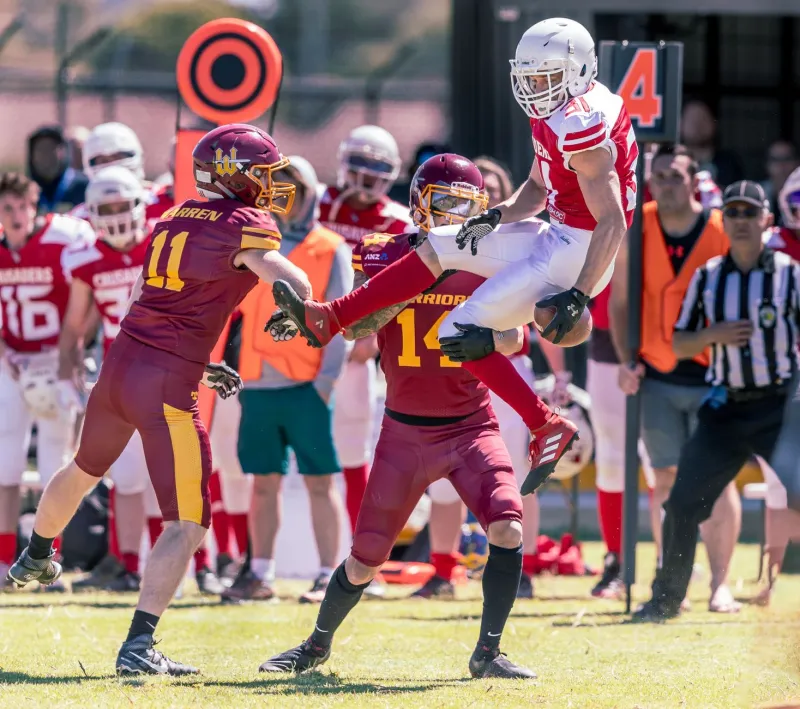
Beyond sensory acuity, finger dexterity plays a central role in contested catch mechanics. When a flanker secures a pass against coverage, the catch is rarely clean. The ball may be deflected slightly. The receiver's body may be off-balance. The catch window may have compressed due to a late throw or a route adjustment.
In these circumstances, the receiver must perform what biomechanists call a "dynamic grip correction" — a rapid, coordinated adjustment of finger tension and position that redirects the ball from an insecure contact point to a stable one. This correction happens in milliseconds and requires independent, precise movement from each finger.
Smaller hands, on average, demonstrate superior intrinsic muscle coordination — meaning the small muscles within the hand that control individual finger movement tend to operate with greater independence and speed. Larger hands, while capable of generating more raw grip force, can be slower to execute the kind of nuanced, multi-finger adjustment that contested catches demand.
This is not a universal rule. Individual variation matters enormously. But it helps explain why some flankers with hand measurements below the prototypical threshold consistently post elite catch rates in contested situations — and why some receivers with ideal hand size still struggle when coverage tightens.
Retraining the Grip: What This Means for Flanker Development Programs
For competitive flankers and the coaches who develop them, the implications of this research are practical. If the decisive factors in contested catching are sensory acuity, proprioceptive feedback quality, and finger dexterity — rather than raw hand size — then those factors can be trained.
Textured ball work is one of the most effective tools available. Training with balls of varying surface textures forces the mechanoreceptors in the fingertips to adapt to novel sensory inputs, improving the speed and accuracy of grip feedback signals. Receivers who train exclusively with standard footballs are, in effect, limiting their sensory vocabulary.
Isolated finger resistance training — using small resistance bands or specialized grip tools to work individual fingers through their full range of motion — builds the intrinsic muscle strength and coordination that dynamic grip corrections require. This is distinct from general grip strength work, which typically emphasizes the larger extrinsic muscles of the forearm.
Distraction-catch protocols — drills in which the receiver is required to secure the ball while simultaneously processing a competing cognitive stimulus — develop the ability to execute grip corrections automatically, without conscious attention. In a game situation, a flanker's conscious attention is occupied by coverage reads, route adjustments, and body control. The grip correction must happen below the level of deliberate thought.
Challenging the Prototype Without Abandoning Standards
None of this suggests that hand size is irrelevant. In certain situations — jump balls, high-point catches, plays where a receiver must pluck the ball above the frame of a taller defender — a larger hand span provides a genuine geometric advantage. Recruitment standards exist for reasons that are not entirely unfounded.
What the biomechanical evidence does challenge is the assumption that hand size is a reliable ceiling on a flanker's contested catch ability. For athletes who have been told their hands are a liability, the research offers a different framework: the relevant question is not the size of the hand, but the quality of its sensory processing and the precision of its motor coordination.
Those qualities are trainable. And for competitive flankers committed to developing every available edge, that distinction matters.
The Competitive Takeaway
Elite athletic development is, at its core, the discipline of questioning inherited assumptions about what the body can and cannot do. The conventional wisdom around hand size in receiver evaluation is one such assumption — one that has shaped recruiting decisions, roster constructions, and athlete self-assessments for decades.
The biomechanical and neurological evidence suggests that this assumption deserves scrutiny. For flankers operating in the contested catch environment that defines competitive football, the decisive variables are not the ones the measuring tape captures. They are the ones that live in the fingertips — in the speed and richness of sensory feedback, in the precision of grip adjustment, in the capacity to make the right correction before the moment has passed.
That is the catch window paradox resolved: the smaller the hand, the closer it may be to the sensory threshold that elite performance actually demands.