Hard Training, Fewer Injuries: The Counterintuitive Science Behind Durable Flankers

There is a persistent belief in American football culture that managing an athlete's workload means dialing back intensity whenever possible. Rest more. Avoid heavy loads. Protect the body by keeping it comfortable. For flankers operating at the competitive level, this philosophy is not just misguided — it may be actively counterproductive.
A growing body of sports science research, combined with the real-world outcomes observed in elite receiver development programs, points toward a striking conclusion: athletes who train with controlled aggression — high-intensity, explosive, structurally demanding work — tend to suffer fewer injuries over the course of a season than those who follow conservative, low-load programming. Understanding why requires a closer examination of how the human body actually responds to stress.
Tissue Adaptation: The Body Strengthens What You Challenge
At the foundation of this discussion is a physiological principle that has been understood in research settings for decades but remains underutilized in many training programs. Connective tissue — tendons, ligaments, fascial networks — adapts in direct response to the mechanical demands placed upon it. When athletes subject those tissues to progressive, controlled stress, the body responds by reinforcing structural integrity at the cellular level.
Collagen synthesis accelerates. Tendon stiffness improves, which translates directly to more efficient force transfer during explosive movements. Bone density increases in the specific load-bearing areas most relevant to the demands of a flanker's route tree. The result is an athlete whose structural foundation has been purposefully hardened against the kind of contact, deceleration, and directional change that defines life on the perimeter.
By contrast, athletes who consistently train below the thresholds required to stimulate meaningful tissue adaptation remain structurally underprepared for the forces they will encounter on game day. Their tissues have not been asked to handle high loads, so when those loads arrive — as they inevitably do in competitive play — the structural response is inadequate. The injury risk does not disappear through conservative programming; it simply goes unaddressed.
The Role of Neuromuscular Readiness
Injury prevention is not purely a structural conversation. A significant percentage of soft-tissue injuries sustained by wide receivers and flankers occur not from excessive external force, but from a failure of neuromuscular coordination — the body's inability to stabilize a joint or decelerate a limb quickly enough to prevent damage.
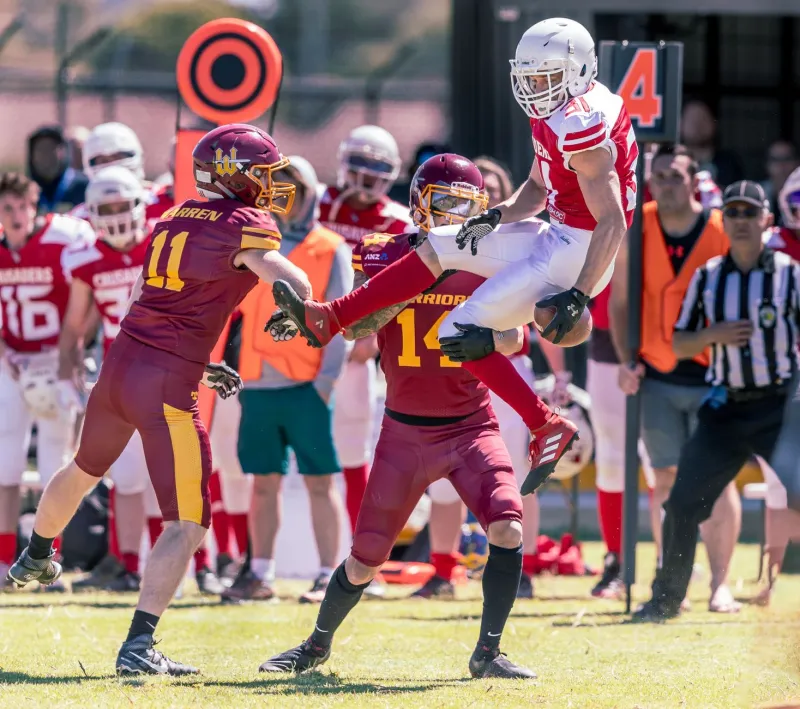
This is where aggressive, high-intensity training delivers one of its most underappreciated benefits. Explosive training modalities — plyometrics, sprint variations, Olympic lifting derivatives, reactive change-of-direction work — develop the neuromuscular system's capacity to fire rapidly and in the correct sequence under fatigue. The motor patterns required to land safely from a contested catch, to decelerate out of a deep crossing route, or to absorb contact while maintaining body control are rehearsed through high-demand training, not through cautious, low-speed repetitions.
Athletes who have spent significant training time in high-intensity environments have, in effect, educated their nervous systems to respond appropriately when the body is placed in vulnerable positions. That education does not happen in a conservative program.
Structural Work as the Non-Negotiable Foundation
It is important to clarify what aggressive training does not mean. Intensity without structure is not a performance strategy — it is a path toward exactly the kind of breakdown that cautious coaches fear. The distinction that separates high-performing flanker programs from reckless ones lies in the deliberate integration of structural preparatory work.
Before any athlete progresses into genuinely high-intensity loading, a well-designed program establishes foundational movement quality. Hip hinge mechanics must be reliable under fatigue. Single-leg stability needs to be sufficient to support the asymmetrical demands of route running. The posterior chain must be developed to a baseline standard before sprint volumes are escalated.
When this structural foundation is in place, the introduction of aggressive training stimuli becomes genuinely productive rather than hazardous. The tendons have been conditioned to accept load. The stabilizing musculature is prepared to protect the joints. The nervous system has been trained to fire in the correct sequence. The athlete can now operate at high intensity with a structural margin of safety that a conservative athlete simply does not possess.
Practical Application: What Aggressive Programming Looks Like
For competitive flankers looking to apply these principles, the programming implications are specific and actionable.
Progressive overload must be real, not performative. Load increases should be systematic and tracked. If a flanker's Romanian deadlift has not increased in three months, the structural adaptation stimulus has stalled. Honest progression is the mechanism through which tissue resilience is built.
Sprint work should be conducted at genuine maximum velocity. Many programs claim to include speed development but cap efforts at 80 or 85 percent to manage perceived risk. True top-end velocity training is where the neuromuscular adaptations most relevant to injury prevention are developed. Avoiding it does not protect the athlete — it leaves a critical adaptation unaddressed.
Plyometric progressions should escalate over time. Box jumps and broad jumps are introductory tools. Competitive flankers need to progress through reactive and depth-based plyometric variations that train the stretch-shortening cycle under conditions that approximate game demands. The tissues must be asked to handle real elastic stress before they will adapt to it.
Deceleration training deserves dedicated programming. A significant percentage of lower-extremity injuries occur during the deceleration phase of movement, not during acceleration. Specific work on controlled deceleration mechanics — from sprint cutoffs to landing mechanics — trains the body to manage the forces that cause the most damage.
Rethinking the Definition of Athlete Protection
The most important shift that coaches and athletes must make is conceptual. Protecting an athlete does not mean minimizing the demands placed on their body. It means preparing their body to handle the demands that competition will inevitably impose.
A flanker who has spent an offseason in a genuinely challenging, structurally sound training program arrives at camp with tendons that have been stress-tested, a nervous system that has been trained to respond under load, and a structural baseline that gives them a meaningful margin against the forces of the game. That is athlete protection.
A flanker who has spent that same offseason in a cautious, low-intensity program arrives structurally unprepared. The first time a defensive back delivers unexpected contact at the top of a route, or the first time a sharp cut is demanded on compromised footing, the gap between training stimulus and game demand becomes an injury.
Elite flanker development programs understand this distinction. The goal is not to avoid stress — it is to build an athlete who is structurally and neurologically equipped to absorb it. Aggressive training, executed within a thoughtful and progressive framework, is the most effective tool available for achieving exactly that.