Pressure-Proof Hands: How Elite Flankers Turn Shrinking Windows Into Scoring Opportunities
There is a persistent assumption in receiver development circles that the best flankers succeed in tight coverage because they possess superior physical tools—longer arms, faster hands, a more refined catch radius. While physical attributes certainly matter, they explain far less than most coaches and athletes believe. The receivers who consistently convert contested, compressed-window passes are not simply more gifted. They are more prepared, and the nature of that preparation is worth examining in precise detail.
The conventional wisdom holds that a shrinking throwing window is primarily a physical problem. The reality is that it is primarily a perceptual one.
What Actually Happens When the Window Closes
When a quarterback releases a pass into a tight window, the flanker has already made a series of decisions that will either position him to make the catch or leave him scrambling to recover. By the time the ball is in the air, the outcome is largely determined by what happened in the two to three seconds before the throw.
Elite flankers process coverage information at a different rate than developing receivers. Research in sport psychology consistently demonstrates that experienced athletes in high-speed environments do not simply react faster—they anticipate more accurately. They read the positioning of a safety rotating into the window, the depth of a corner's cushion, and the leverage of a linebacker dropping into zone coverage simultaneously, and they use that information to pre-calibrate their body position before the ball arrives.
This is not instinct. It is trained perception, and it is teachable.
The Spatial Awareness Gap
One of the most underappreciated developmental gaps between elite and average flankers is spatial self-awareness under pressure. An elite receiver knows precisely where his body is relative to the sideline, the first-down marker, a closing defender, and the incoming trajectory of the football—all at once. Average receivers tend to narrow their focus under pressure, which is a natural cognitive response to stress but a catastrophic one for a player trying to execute a technically demanding catch.
This narrowing of attention is sometimes called perceptual tunneling, and it is one of the primary reasons talented receivers who perform well in practice suddenly lose their effectiveness in critical game moments. The environmental pressure of a stadium, a playoff atmosphere, or a two-minute drill triggers a stress response that constricts the receiver's perceptual field at precisely the moment when broad awareness is most necessary.
Training programs that address this gap deliberately expose athletes to increasing levels of complexity and pressure during skill development, forcing the nervous system to maintain broad awareness even as environmental demands intensify.
Positioning as a Pre-Catch Skill
Most receiver coaching focuses on what happens after the ball arrives—hand placement, eye discipline, tuck and run mechanics. These are legitimate and important technical elements. However, elite flanker development must place equal emphasis on the positioning decisions that occur before the catch, because those decisions determine whether the catch is even possible.
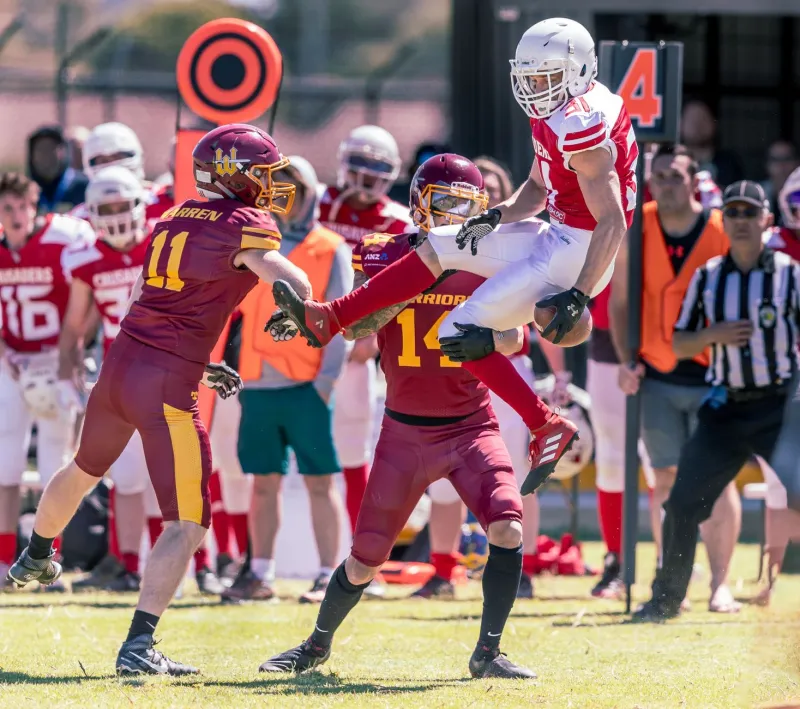
Consider a crossing route in which a linebacker is carrying the flanker through the intermediate zone. An average receiver runs the route to its designed depth and waits. An elite receiver is constantly making micro-adjustments—subtle changes in hip angle, shoulder lean, and foot placement—that create fractional advantages in separation while simultaneously setting up a favorable catch position if the quarterback decides to throw into the window.
These micro-adjustments are not improvisational. They are the product of extensive film study, repetition-based muscle memory, and an internalized understanding of leverage principles. The elite flanker is not guessing. He is executing a system that has been rehearsed until it operates below the level of conscious thought.
The Counter-Intuitive Role of Comfort With Discomfort
Perhaps the most counter-intuitive finding in elite receiver development is that the athletes who perform best in tight windows are not necessarily those who find the situation comfortable. They are the ones who have trained extensively in conditions that are uncomfortable and have learned to execute technical skills precisely while under duress.
This distinction matters enormously for program design. A training environment that consistently removes difficulty in the name of building confidence may actually undermine a flanker's ability to perform in the compressed windows that define high-stakes moments. The athletes who thrive when coverage tightens and the margin for error narrows are those whose training has normalized difficulty rather than avoided it.
This does not mean that training should be chaotic or that technical development should be sacrificed for toughness. It means that technical skill must be developed progressively under conditions of increasing complexity until the athlete can execute with precision in the most demanding environments the game produces.
Practical Training Frameworks
Translating these principles into a functional training program requires deliberate structure. Several approaches have demonstrated consistent results at the competitive level.
Perceptual loading drills introduce cognitive demands alongside physical execution. A flanker running a route while processing color-coded signals from a coach, for example, must maintain technical discipline while dividing attention—a condition that mirrors the perceptual demands of a live game environment.
Compressed window catching progressions begin with standard catch mechanics and gradually introduce simulated coverage pressure through the use of defenders, training aids, or constraint-based setups that force the receiver to adjust his catch technique based on the available window. These progressions build the adaptability that allows elite flankers to modify their hand positioning and body angle in real time.
Decision-speed film review pairs video analysis with timed response tasks. Rather than reviewing film passively, athletes are challenged to identify coverage rotations and predict quarterback decision points within a defined time window. This trains the pre-snap and mid-route recognition skills that allow elite flankers to process defensive information at the speed the game demands.
Developing the Competitive Standard
For competitive flankers at the high school, collegiate, or professional level, the goal is not simply to improve catch percentage in isolation. The goal is to raise the standard of what constitutes a catchable ball. Elite receivers consistently convert passes that average receivers classify as uncatchable—not because they are physically superior in every dimension, but because their training has expanded their definition of what is possible in a compressed window.
This is the standard that Flanker Training exists to develop. The difference between a receiver who fades when coverage tightens and one who rises is not talent alone. It is the quality, specificity, and progressive challenge of the training environment that shaped them.
The window does not have to be a barrier. In the hands of a properly prepared flanker, it becomes an advantage.