Possession by Design: Engineering Ball Security Into Every Phase of a Flanker's Route
In competitive football, the fumble is more than a statistical blemish. It is a momentum transfer, a field position catastrophe, and — at the elite level — a direct indictment of a receiver's technical preparation. For flankers operating in traffic-heavy zones across the middle of the field, ball security is not a finishing touch applied after catching the football. It is a discipline that must be woven into every phase of route execution, from the break to the extension to the moment of first contact after the catch.
The flankers who consistently protect the football in high-volume receiving roles do not rely on instinct alone. They operate according to a set of biomechanically sound habits that reduce vulnerability during the precise windows when the ball is most at risk.
Understanding the Vulnerability Window
Before addressing solutions, it is worth identifying exactly when a flanker is most susceptible to a fumble. Research in sports biomechanics and extensive film study across collegiate and professional programs point to three distinct windows of elevated risk.
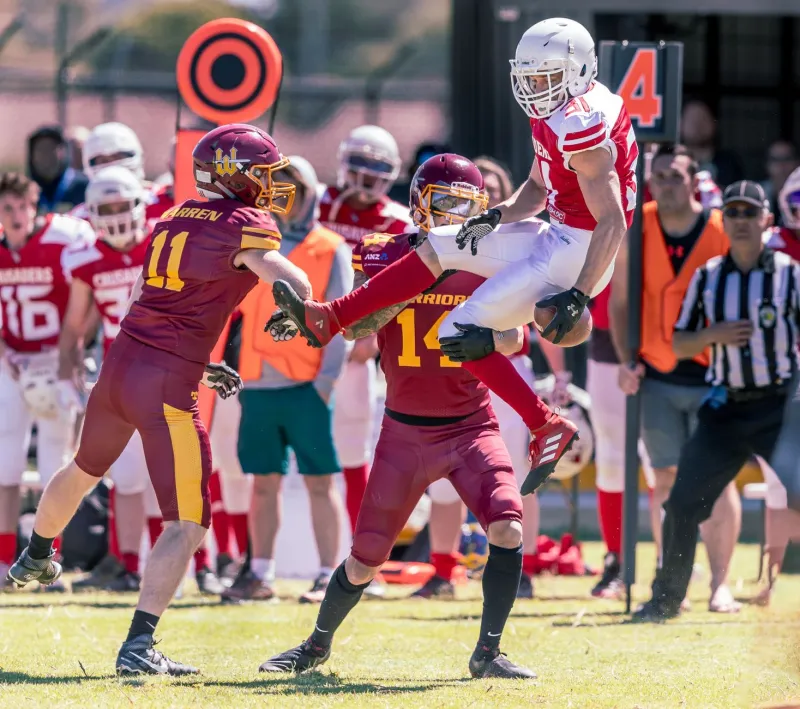
The first occurs at the moment of catch completion — specifically the transition from securing the ball with both hands to tucking it into a single-arm carry position. The second window opens during the initial two to three steps after the catch, before the receiver has fully reestablished body control and forward momentum. The third, and perhaps most underappreciated, is the contact absorption phase — the moment a defender's shoulder, helmet, or hand strikes the ball carrier before a secure tuck has been established.
Understanding these windows allows coaches and athletes to design training interventions that address real risk rather than general ball-handling repetition.
Grip Pressure Modulation: The Undercoached Variable
Most ball security coaching focuses on the tuck — where the ball sits relative to the forearm, elbow, and ribcage. This is important, but it addresses only half the equation. Grip pressure modulation — the deliberate adjustment of squeeze intensity throughout the catch-and-carry sequence — is a critical variable that receives far less attention.
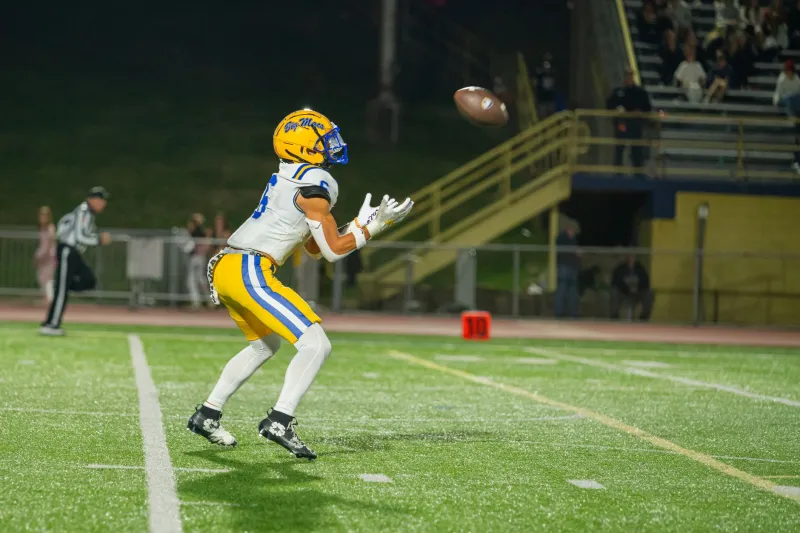
Elite flankers do not apply uniform grip pressure across all phases of a play. During the extension phase of a catch, grip pressure is necessarily lighter to allow the hands to work independently and track the ball cleanly. The technical error many receivers make is failing to transition from catch grip to carry grip with sufficient speed and decisiveness.
Training this transition requires deliberate, isolated repetition. Coaches at the advanced level use resistance band attachments and weighted ball drills specifically designed to develop the neuromuscular response that triggers an automatic grip intensification in the milliseconds following catch completion. The goal is to make that transition involuntary — an embedded reflex rather than a conscious decision made under duress.
Hand Placement Timing Relative to Contact
The sequence in which a flanker's hands move from catch position to carry position must be timed against the anticipated arrival of contact. This is where the intersection of route intelligence and physical technique becomes critical.
A flanker running a crossing route over the middle knows — or should know — that contact is arriving from a specific angle within a predictable time frame after the catch. Elite receivers use this anticipatory knowledge to accelerate the tuck sequence before contact lands, rather than attempting to secure the ball in response to the hit.
This is a meaningful distinction. Reactive ball security — tightening the grip after contact — is inherently slower and less reliable than proactive ball security, which involves completing the tuck while the receiver still has a half-step of protection before the collision.
Developing this skill requires scenario-based training where defenders are instructed to time their contact at realistic intervals following the catch. The receiver must learn to read the closing speed of the defender and compress the tuck timeline accordingly. Over time, this develops a form of contact anticipation that is inseparable from the catching motion itself.
Integrating Ball Security Into Conditioning Without Sacrificing Catch Radius
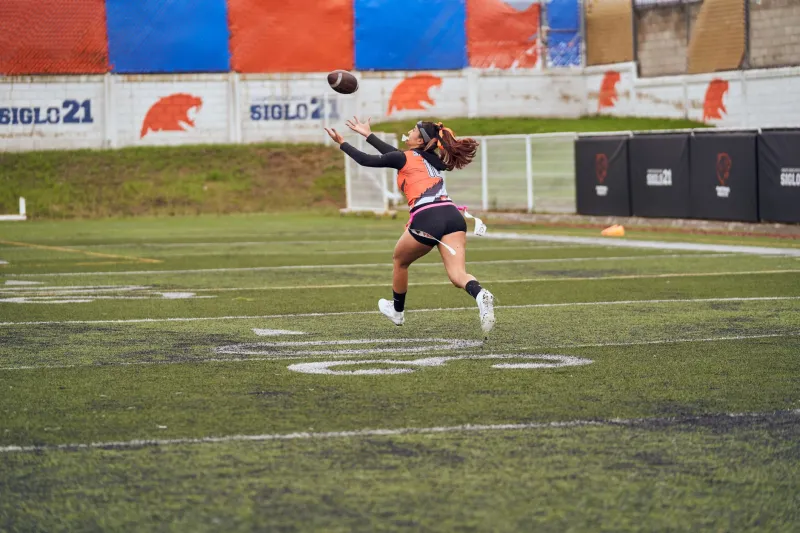
One of the persistent concerns among receivers and their coaches is that an emphasis on ball security will compromise catch radius — the ability to extend fully and catch the football at its widest point from the body. This concern is legitimate but solvable.
The key is sequencing. Ball security mechanics are applied after the catch is made, not during it. The training error that produces stiff, limited receivers is teaching security-first habits that cause athletes to contract their catch radius prematurely in anticipation of the tuck. When this happens, receivers begin catching the ball closer to their body, reducing their effective catching range and increasing the probability of drops.
The technical solution is to train the two phases — extension and tuck — as distinct but continuous actions with a clean handoff between them. Plyometric catch-and-carry drills performed at game speed, combined with directional change immediately following the catch, teach the body to complete a full extension before initiating the tuck sequence. When this pattern is reinforced consistently, the receiver does not experience a conflict between reach and security.
Condition this during metabolic training as well. Receivers who practice ball security only in controlled, low-fatigue environments will revert to poor habits when their cardiovascular system is under stress. Incorporating ball-in-hand conditioning — shuttle runs, contested catch sequences at the end of practice, and full-speed route trees with immediate contact — ensures that security mechanics are available when physical resources are depleted.
The Tuck Checklist: Building a Repeatable System
Elite coaches often provide their receivers with a simplified tuck checklist — a short sequence of physical cues that can be executed automatically under pressure. While individual programs vary, the most effective frameworks share common elements.
First, the elbow drives down to anchor the ball against the ribcage. Second, the wrist rotates inward so the hand covers the front tip of the football, eliminating the leading edge that defenders target during strip attempts. Third, the opposite arm engages to provide secondary protection in contact situations. Fourth, the receiver's eyes lift immediately to the field rather than dropping to confirm the tuck — a habit that both improves vision and prevents the dangerous head-down posture that increases fumble risk on contact.
This sequence, when drilled to automaticity, becomes part of the receiver's motor program — executed without deliberate thought in the same way an elite sprinter does not consciously think about arm mechanics at top speed.
Building the Complete Ball-Carrier
The flanker position demands a paradox of physical expression: maximum reach and extension in one moment, followed immediately by maximum compression and protection in the next. The athletes who resolve this paradox most effectively are not simply talented — they are systematically trained.
Ball security is not a separate category of skill development. It is the final chapter in the story of every route run, and it must be authored with the same precision applied to release technique, route depth, and separation mechanics. When coaches build programs that treat possession protection as a foundational athletic competency rather than a corrective measure applied after a fumble, the result is a flanker who is not only productive — but reliably, durably productive when the game is on the line.