Reach Further, Decide Faster: The Paradox at the Core of Elite Catch Radius Development
There is a quiet contradiction living inside every elite flanker's development arc. The wider a receiver trains his catch radius — the more territory he claims around his body as catchable space — the less time his visual processing system has to confirm, track, and secure the ball. Coaches talk endlessly about expanding the catch window. What they discuss far less often is the cognitive cost of doing so.
Understanding that cost, and learning to manage it systematically, is what separates receivers who occasionally make spectacular catches from those who make difficult receptions look routine.
The Visual Processing Constraint Nobody Talks About
When a football travels toward a receiver's core, the eyes have a relatively generous window to pick up spin, trajectory, and final position. The brain's visual cortex receives consistent, high-quality input across the entire flight path. Peripheral and central vision work in concert, and the hands have time to adjust.
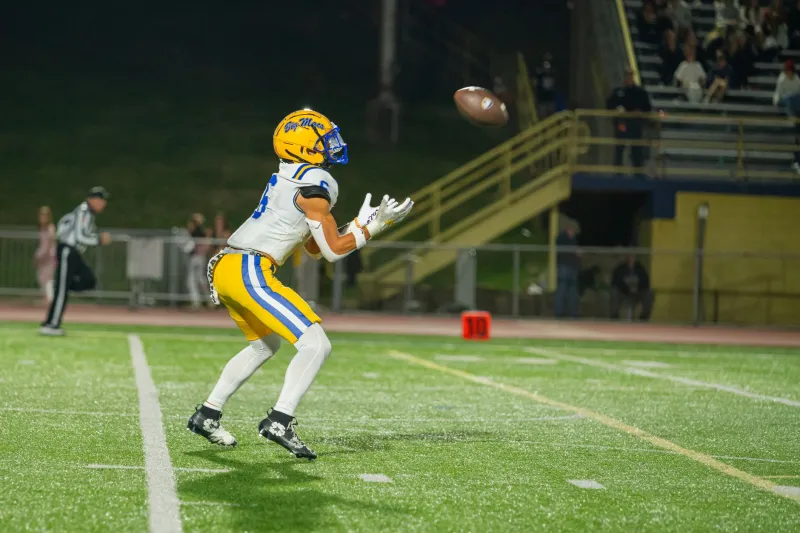
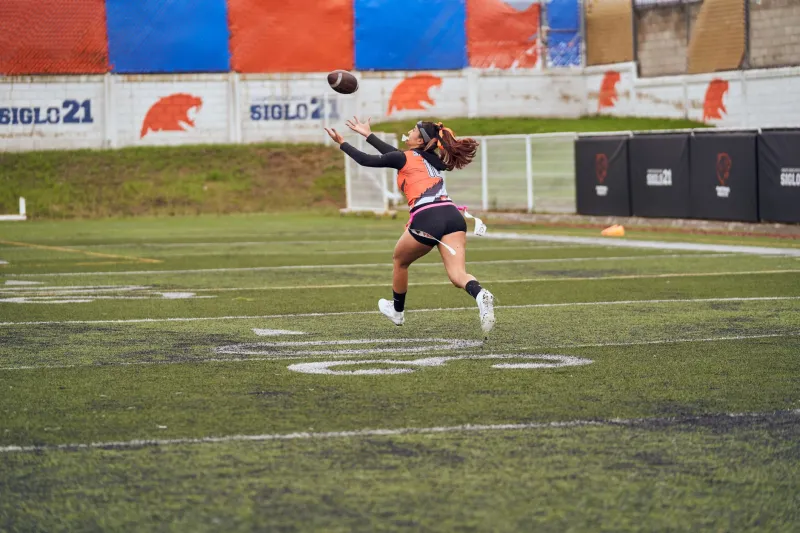
Extend that same catch to a ball thrown two feet outside the frame of the body — a sideline back-shoulder fade, a slant thrown behind the hips, a seam route where the quarterback leads slightly wide — and the processing equation changes dramatically. The ball enters the visual field at an oblique angle, often transitioning from peripheral to central vision at the last possible moment. Research in sports vision science consistently shows that reaction time for objects entering peripheral vision is measurably slower than for objects tracked centrally. The hands, meanwhile, must travel farther from the body's center of mass, reducing fine motor control and increasing the margin for error at the moment of contact.
The paradox is structural: the wider the catch, the shorter the reliable decision window, precisely when a longer window would be most useful.
Why Conventional Radius Drills Fall Short
Most catch radius training programs address the physical dimension of the problem — and only the physical dimension. Receivers work JUGS machine sessions with balls thrown progressively wider, run high-point drills, and practice one-handed extensions. These drills build flexibility, body awareness, and hand strength, all of which matter.
What they rarely address is the cognitive compression that accompanies extension. When an athlete reaches laterally or away from his frame, his focus often narrows to the mechanics of the reach itself. The ball's spin axis, the final adjustment of the fingertips, the tuck — these cues get processed sequentially rather than simultaneously. Under game speed and defensive contact, that sequential processing is too slow. The drop rate on extended catches in live competition is substantially higher than in isolated drill work, and the gap is not primarily physical. It is perceptual.
Elite development programs must close that gap deliberately.
Collapsing the Paradox: Three Training Principles
1. Anchor Peripheral Tracking Before Extending the Reach
Before a flanker can be trusted to secure a ball at the boundary of his catch radius, he needs to train his visual system to pick up the ball's spin and trajectory earlier in its flight path — specifically while it is still within the peripheral field. Drills that use colored ball panels, varied spin rates, or deliberate trajectory changes force the visual cortex to build faster peripheral identification habits. When the brain can confirm ball identity and trajectory earlier, it buys back milliseconds that extension would otherwise consume.
Practical application: Incorporate reaction catch drills using a partner stationed behind and to the side of the receiver. The ball is released from outside the receiver's direct line of sight, requiring peripheral pickup before the extension begins. Progress from stationary to full route speed over a four-to-six week cycle.
2. Train the Hands to Lead the Eyes on Extended Catches
This principle inverts conventional catching instruction. Most coaching cues direct the eyes to the ball first, with the hands responding. For catches within the core reception zone, this sequencing is sound. For extended catches, the hands must begin moving toward the projected catch point while the eyes are still confirming the ball's path — not after.
This is not guesswork. It is anticipatory motor programming, the same cognitive mechanism that allows elite infielders in baseball to begin their glove movement before the ball leaves the bat. In receiver training, it is developed through repetitive route-and-catch sequences where the ball placement is scripted in advance, allowing the athlete to build accurate predictive models of where the ball will arrive based on quarterback release mechanics and route geometry. Over time, those models become automatic, freeing the visual system to confirm rather than initiate.
3. Introduce Defensive Contact at the Point of Extension
An extended catch in a game environment almost always occurs simultaneously with defensive disruption — a cornerback's hand at the wrist, a safety arriving from the backside, a press technique that shifts the receiver's balance at the moment of reach. Training extended catches in isolation builds a skill set that partially transfers to competition. Training them under controlled contact builds a skill set that transfers fully.
Coaches should phase in resistance band resistance, coach-applied hand pressure, and eventually live defensive contact during extended catch sequences. The objective is not to simulate punishment — it is to teach the nervous system to complete the catch decision under proprioceptive interference, the same interference that exists on every third-down conversion attempt in a real game.
The Mental Framework: Shrink the Decision, Not the Awareness
Elite receivers who consistently make difficult catches in tight coverage share a cognitive habit that distinguishes them from their peers: they do not try to process more information during an extended catch. They process less — and they do so deliberately.
By pre-loading route geometry, quarterback tendencies, and defensive alignment reads at the pre-snap and stem phases of the route, the best flankers arrive at the catch point with their decision already narrowed to a single variable: ball contact. The mental bandwidth that a less-prepared receiver spends on catch-point calculation, a prepared receiver has already allocated to execution.
This is why film study and pre-snap recognition training are not separate disciplines from catch radius development. They are prerequisites for it. The flanker who has already answered the question — where is this ball going and how do I need to position my hands — before the quarterback releases is the flanker whose visual processing system has the capacity to manage the compressed window that extension demands.
Building the Complete Receiver
The most dangerous flankers in competitive football are not simply the ones with the longest arms or the most refined hand technique. They are the ones whose physical tools and cognitive systems operate on the same timeline — athletes who have trained their bodies and minds to function as a unified response mechanism rather than a sequence of separate processes.
Expanding the catch radius is a worthwhile and necessary goal. But the training system that supports it must account for the full paradox: reaching farther demands deciding faster, and deciding faster requires building a perceptual and cognitive infrastructure that makes faster decisions possible.
That infrastructure is trainable. The athletes who develop it become the receivers defenses cannot scheme against — because there is no coverage design that accounts for a flanker who can catch anything, anywhere, with no hesitation.