When Practice Reps Don't Transfer: Solving the Contested Catch Breakdown in High-Stakes Moments
The Practice-to-Game Transfer Problem
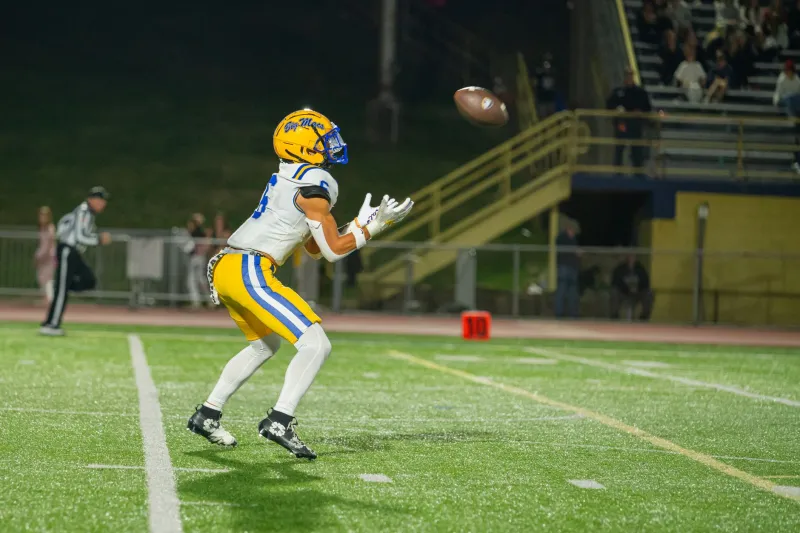
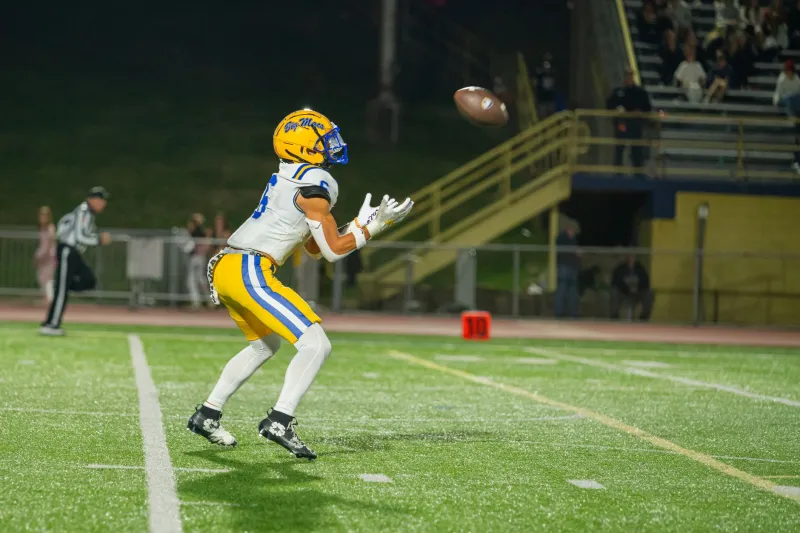
Every serious flanker has experienced it. A catch that felt automatic during Thursday's walkthrough becomes a bobble—or worse, a drop—on third and seven in front of a packed house. The ball hits the hands the same way. The route was clean. The timing was there. And yet the reception fails.
This phenomenon is not a mystery, nor is it simply a matter of mental weakness. It is a documented performance gap rooted in the intersection of biomechanics, visual processing, and nervous system overload. Understanding why the contested catch collapses under pressure is the prerequisite to building a training system that actually closes that gap.
Hand Placement Drift Under Defensive Proximity
In an isolated catch drill, a flanker's hand mechanics are governed by deliberate motor programming. The thumbs align, the fingers spread naturally, and the catch surface forms without conscious effort. That automaticity is the product of thousands of repetitions executed without meaningful interference.
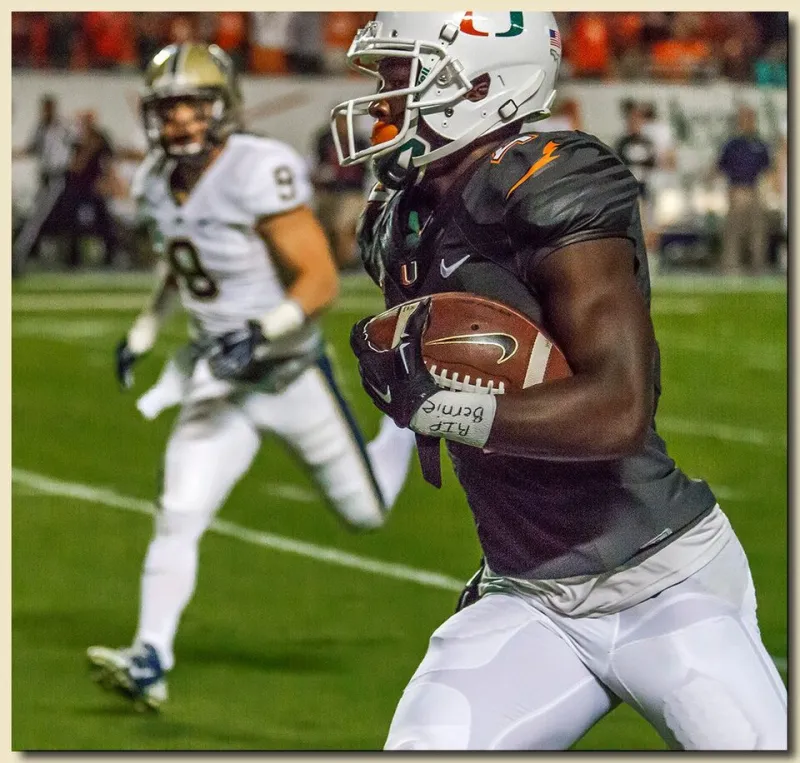
Introduce a defender into that equation and the nervous system registers a threat. Physical proximity—even when contact has not yet occurred—activates a protective motor response. Hands begin to anticipate collision rather than reception. Fingers tighten prematurely. The catch window, which should remain open through ball arrival, begins to compress a fraction of a second too early.
Research in motor learning consistently shows that defensive proximity shifts a receiver's motor attention from the ball to the defender. The result is what practitioners call target substitution: the athlete's neuromuscular system begins preparing for a collision event rather than a catching event, and hand placement reflects that substitution before the receiver is consciously aware of it.
For flankers working in traffic along the boundary or across the middle of the field, this is not an occasional problem. It is a structural vulnerability embedded in the way the nervous system processes simultaneous physical threats and fine motor tasks.
Visual Tracking Decay and the Noise Variable
The second breakdown point is equally well-documented but far less frequently trained. Elite catching mechanics depend on a specific visual behavior: maintaining focal lock on the ball through the final twelve to eighteen inches of flight. This is not passive watching—it is an active, trained behavior that sustains the information pipeline the hands need to make micro-adjustments at reception.
Under stadium conditions, that visual pipeline degrades. Crowd noise does not simply affect focus in an abstract psychological sense. Auditory stress has a measurable impact on visual attention allocation. When ambient noise crosses certain thresholds, the brain begins redistributing attentional resources to process the auditory environment, and visual tracking precision suffers as a consequence.
For a flanker running a crossing route in a hostile environment, this means the focal lock on the incoming ball may break fractionally earlier than it would in a quiet practice setting. That fraction of a second is enough to cost the receiver critical adjustment information. The hands arrive at an approximation of where the ball should be rather than where it actually is—and contested catches do not forgive approximations.
Proprioceptive Overload and the Collapse of Body Awareness
The third component of the contested catch breakdown is perhaps the most underappreciated: proprioceptive overload. Proprioception—the body's internal sense of position and movement—governs how a flanker manages his frame during the catch sequence. It tells him where his hands are relative to his body, how much extension he can safely generate, and how to maintain balance while absorbing ball contact.
When a defender is present, the proprioceptive system is simultaneously managing multiple competing inputs: the flanker's own body position, the defender's physical presence, anticipated contact, balance preservation, and the incoming ball trajectory. In practice, most of those inputs are absent. The nervous system is free to dedicate its proprioceptive bandwidth almost entirely to the catch.
In a game, that bandwidth is split. And when proprioceptive resources are stretched across too many simultaneous demands, the catch mechanics—the most recently acquired layer of the movement sequence—are the first to degrade.
Building a Progressive Training System That Closes the Gap
The solution is not simply to add more reps. Volume without specificity will not address the neurological root causes described above. What is required is a progressive overload system that systematically introduces the stressors responsible for game-day breakdown—defensive proximity, auditory interference, and proprioceptive competition—in a controlled, graduated sequence.
Phase One: Baseline Hand Mechanics Under Isolation Before adding stressors, establish a measurable baseline. Use high-speed video to document hand position, catch window dimensions, and finger tension at ball contact during clean, uncontested reps. This baseline becomes the performance standard against which degraded reps will be compared throughout the program.
Phase Two: Progressive Proximity Introduction Begin adding a passive defender—a coach or teammate who stands within arm's reach but does not contest the catch. The goal is not to simulate a full jam or disruption; it is to activate the nervous system's proximity response while the flanker learns to override it. As competency builds, the defender becomes gradually more active: first moving into the catch window, then making light contact, then applying full contested pressure.
Phase Three: Auditory Stress Loading Introduce crowd noise via high-quality audio playback during catch reps. Begin at moderate volume and increase systematically across sessions. Pair this with explicit visual tracking cues—coaches calling out ball color markings at the moment of reception to force sustained focal lock. The athlete learns to maintain visual discipline even as the auditory environment escalates.
Phase Four: Dual-Task Proprioceptive Challenges Layer in proprioceptive competition by requiring the flanker to execute contested catches while managing secondary physical tasks: catching off an uneven surface, receiving while absorbing a simultaneous shoulder contact from a pad, or completing the catch sequence while transitioning immediately into a balance recovery movement. These drills force the nervous system to protect catch mechanics even when proprioceptive bandwidth is under stress.
Phase Five: Full Integration Under Simulated Game Conditions Combine all three stressor categories in a single training environment. Contested catches in full crowd noise, with active defenders, on surfaces that require balance management. Film every rep. Compare hand mechanics, visual behavior, and catch window dimensions against the Phase One baseline. The gap between those two data points is the precise measure of transfer.
Why This Matters at the Competitive Level
At the highest levels of competition, the difference between a flanker who is available on third down in a hostile road environment and one who is not often comes down to exactly this kind of training specificity. Teams do not lose games because their receivers cannot catch in practice. They lose them because their receivers have not been trained to catch under the specific neurological conditions that game situations impose.
The contested catch is not a talent question. It is a training design question. And for competitive flankers serious about performing when the margin for error is smallest, the answer begins with understanding why the breakdown happens—and building a system precise enough to address it at its source.