Train the Weak Link: Why Position-Specific Stress Exposure Is the Most Effective Injury Prevention Strategy for Competitive Flankers
The conventional approach to injury prevention in competitive athletics has long defaulted to a logic of subtraction: identify the movements that carry the highest injury risk and reduce or eliminate exposure to them in training. For flankers, this has historically meant generic conditioning programs, cautious limitations on cutting volume during practice, and a general preference for straight-line speed work over the lateral and rotational demands that actually define the position.
The problem with this approach is that it is physiologically backwards. The human body — specifically its connective tissue, joint stabilizers, and neuromuscular coordination systems — does not become more durable by being shielded from stress. It becomes more durable by being systematically exposed to the precise stresses it will face in competition, at doses and progressions carefully calibrated to drive adaptation rather than damage.
For a flanker, this means that the most effective long-term injury prevention program looks, at the surface level, more dangerous than what most conservative programs prescribe. Understanding why requires a brief examination of how the body actually adapts to positional demands.
The Biological Case for Targeted Stress
Tendon and ligament tissue — the connective structures most vulnerable to the cutting, accelerating, and decelerating demands of a flanker's movement profile — adapts to mechanical loading through a process called mechanotransduction. When tendon tissue is subjected to controlled tensile stress, specialized cells called tenocytes respond by synthesizing new collagen, increasing the structural density and load-bearing capacity of the tissue.
Critically, this adaptation is load-specific. A tendon that is regularly exposed to the lateral shear forces generated by a hard inside cut will develop structural characteristics specifically suited to tolerating that force. A tendon that has been conditioned exclusively through straight-line running or generic gym work will not have developed those specific structural adaptations — and will be structurally unprepared when the lateral shear force arrives in a game situation.
This is the fundamental paradox at the core of position-specific injury prevention: the tissue vulnerability that coaches often try to protect against is not reduced by avoidance. It is reduced by controlled exposure. The flanker who never cuts at full speed in practice does not have healthy tendons — they have undertrained tendons that are waiting to fail at the worst possible moment.
Mapping the Flanker's Specific Movement Demands
Before a position-specific durability program can be constructed, the exact movement demands of the flanker position must be mapped with precision. This is not a generic athletic profile — it is a highly specific constellation of movement patterns that recur with predictable frequency across every game and practice.
The primary movement stressors for a flanker include: acceleration from a static stance, multi-directional cuts executed at high velocity, deceleration under contested conditions, overhead reach and catch mechanics that load the shoulder and elbow complex, and collision absorption at the point of contact with defensive backs. Each of these demands places specific loads on specific tissue structures, and each requires its own targeted adaptation protocol.
The inside cut — a sharp lateral break executed at full route speed — is the single highest-stress movement in a flanker's repertoire. The forces generated at the knee and ankle during a properly executed inside cut are substantial, and the asymmetrical loading pattern means that the plant leg absorbs a disproportionate share of the stress. Any durable flanker program must include progressive loading of this specific movement pattern, beginning at controlled speeds and advancing to full game-speed execution as the tissue adaptations develop.
Joint Stability in Cutting Mechanics: Building From the Ground Up
Joint stability in the context of cutting mechanics is not simply a product of muscular strength. It is a product of the neuromuscular coordination between the muscles, tendons, and proprioceptive sensors that collectively manage joint position under dynamic loading conditions.
For the flanker's knee — the joint most frequently implicated in season-ending injuries at the position — stability during cutting is primarily governed by the coordination between the quadriceps, hamstrings, and hip abductors. When this coordination is well-developed, the knee maintains proper alignment through the deceleration and direction-change phases of a cut, distributing load across the joint structures in a mechanically efficient pattern. When coordination is underdeveloped, the knee collapses into valgus — the inward buckling position associated with ACL injury — under the same cutting forces.
The critical training insight is that this coordination cannot be developed in the gym alone. Isolated strength exercises build the capacity of individual muscle groups, but they do not train the neuromuscular coordination patterns that govern joint behavior during sport-specific movements. That coordination is developed through deliberate practice of the cutting movements themselves, with progressive loading that allows the nervous system to refine its motor programs for joint stability under increasingly realistic conditions.
This is why a flanker who squats impressive weight but has never specifically trained their cutting mechanics under fatigue is not necessarily more durable than a flanker who is less impressive in the weight room but has logged thousands of well-coached cutting repetitions. The gym work builds the raw material. The position-specific movement training builds the coordination system that deploys it correctly.
Micro-Stressor Protocols: The Adaptation Engine
The concept of micro-stressor protocols — deliberately introducing small, controlled doses of the exact stresses that cause injury when they occur at full magnitude — is borrowed from the broader field of load management research and has direct application to flanker durability training.
A micro-stressor protocol for the flanker's cutting mechanics might begin with low-velocity inside cuts executed at 60 percent of game speed, with specific attention to plant foot positioning and knee alignment. Over a training block of four to six weeks, the velocity increases incrementally while monitoring tissue response — soreness, swelling, range of motion — to ensure the adaptation process is proceeding without accumulating damage.
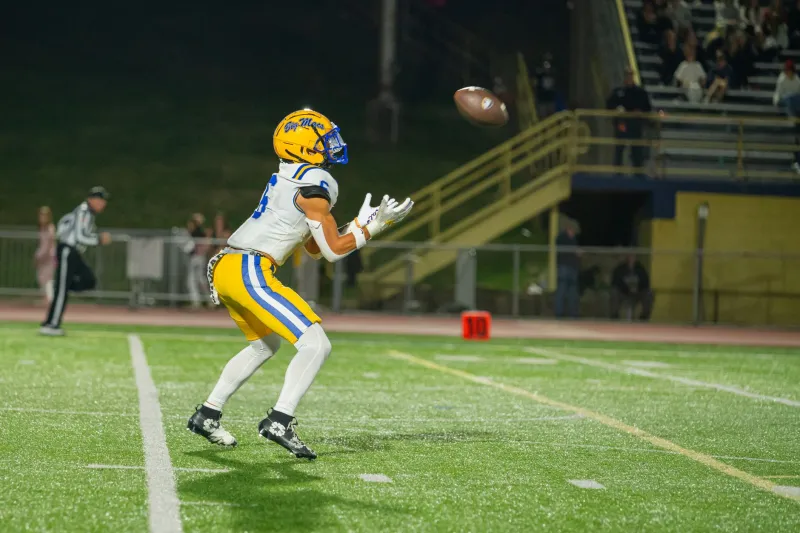
The same principle applies to the shoulder complex. The overhead reaching mechanics of a contested catch place specific loads on the rotator cuff and biceps tendon. A flanker who regularly practices contested catches with resistance — whether through weighted catch training or resistance band loading of the overhead position — develops the tendon density and rotator cuff coordination to handle those loads in game conditions. A flanker who avoids overhead stress in training to protect a previously injured shoulder is, paradoxically, increasing the risk that the shoulder will fail when the game demands what the training has not prepared it for.
Integrating Durability Into the Training Calendar
Position-specific durability work is most effective when it is integrated into the training calendar as a distinct programming priority rather than appended to the end of a strength session as an afterthought. The timing within the microcycle matters: position-specific movement loading should be scheduled when the athlete is sufficiently recovered to execute with mechanical precision, as fatigued cutting mechanics do not build correct neuromuscular patterns — they reinforce the compensatory patterns that produce injury.
During the in-season period, the volume of position-specific durability work decreases while the specificity increases. The goal is to maintain the tissue adaptations developed in the off-season while managing cumulative fatigue. Brief, high-quality exposures to the key movement stressors — a targeted set of full-speed inside cuts, a contested catch circuit, a deceleration loading session — are sufficient to preserve the adaptations without adding to the recovery burden.
The flanker who arrives at the postseason with healthy tendons, stable joints, and a neuromuscular system calibrated for the exact demands of the position did not get there by being protected from stress. They got there because someone understood that durability, like speed and route precision, is a trained quality — and that the training must match the demand.