When Perfect Form Fails: Building Adaptive Route Running That Survives Real Defensive Chaos
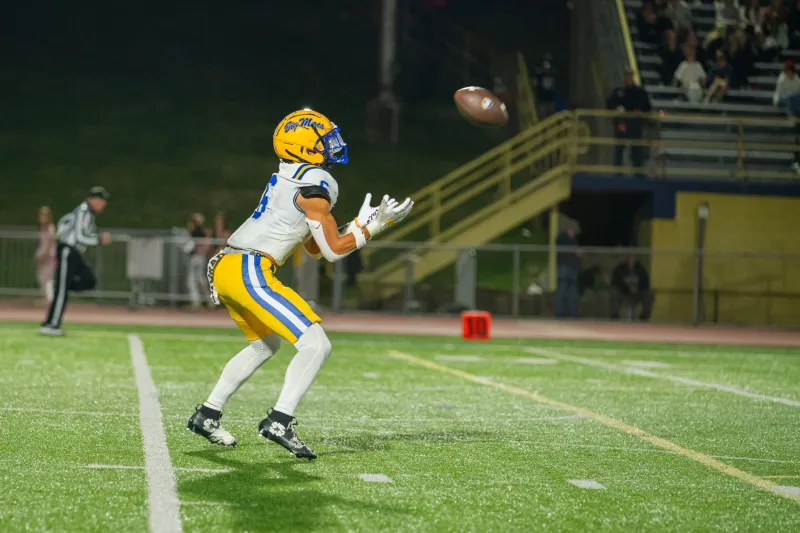
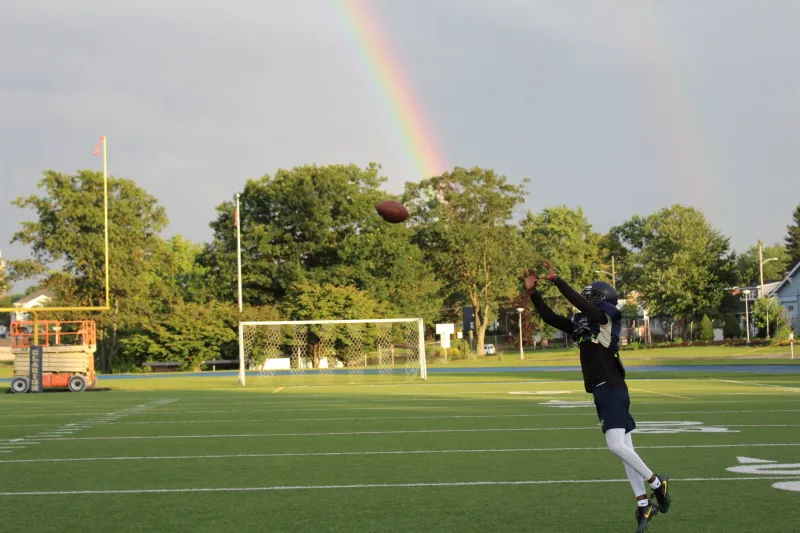
There is a particular kind of receiver who looks exceptional on the practice field. His stem is clean, his break is precise, and his footwork is textbook-perfect on every repetition. Coaches film him. Coordinators point to him. And then, in a critical third-down situation against a defense that rotates coverage at the snap, he hesitates — just long enough to cost his team the conversion.
This is not a story about talent. It is a story about how the pursuit of mechanical perfection, divorced from the conditions of actual competition, can quietly construct a ceiling that athleticism alone cannot break through.
The Illusion of Controlled Mastery
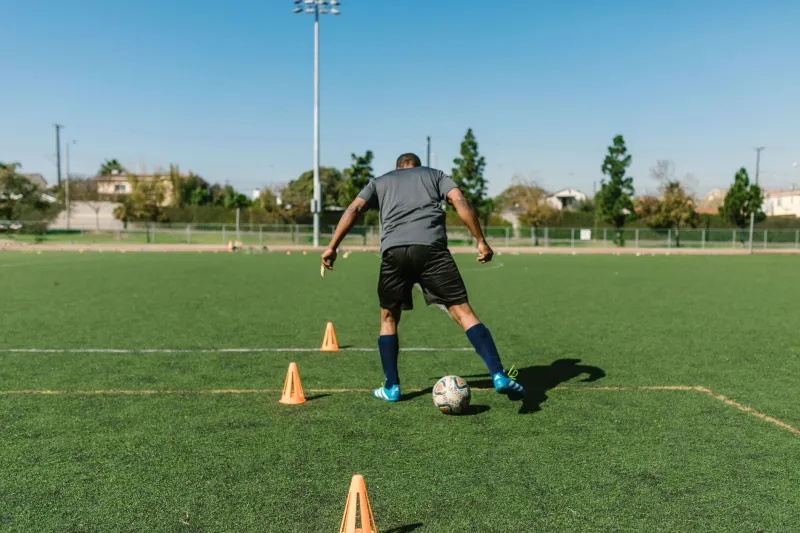
The human brain is extraordinarily good at learning patterns under stable conditions. When a flanker runs the same curl route against the same look, in the same direction, at the same depth, for three hundred repetitions across a training camp, the nervous system encodes that movement sequence with remarkable efficiency. Cognitive scientists refer to this as procedural automation — the brain essentially removes the route from conscious deliberation and executes it as a motor program.
The problem is that procedural automation is context-dependent. The motor program that fires cleanly against an air defender or a compliant scout team does not automatically transfer to a situation where a cornerback is pressing at the line, a safety is rotating late, and the linebacker is dropping into a zone the receiver has never encountered from that alignment.
Research in motor learning consistently demonstrates that skills acquired under low-variability conditions show poor transfer to high-variability environments. For flankers, this means that the technical precision earned through static repetition can become a cognitive trap — a default pattern the brain reaches for precisely when flexible decision-making is most needed.
Why Mechanical Breakdown Looks Like a Physical Problem
Coaches often misdiagnose what is happening when a polished receiver falls apart against elite competition. The observation is typically framed in physical terms: his release was late, his break was slow, his hands were soft on the contested catch. These descriptions are accurate, but they are symptoms, not causes.
What is actually occurring is a processing failure. When a well-drilled flanker encounters a defensive variable his training has not prepared him to interpret, the brain does not smoothly transition to a backup plan. Instead, it experiences a momentary conflict between the automated motor program it wants to execute and the novel input it is receiving. That conflict costs milliseconds. At the professional and advanced collegiate level, milliseconds determine whether a route generates separation or a forced incompletion.
The receiver's body hesitates because his mind is still negotiating. His mechanics appear to break down because the cognitive architecture supporting those mechanics was never built to handle deviation.
The Case for Variable-Stress Training
Addressing this problem requires a deliberate restructuring of how repetitions are designed, not simply more of them. The goal is to train the brain to treat variability as the expected condition rather than the exception.
Variable-stress training introduces unpredictable defensive inputs at every stage of a route, forcing the receiver to make real decisions rather than execute stored programs. This can take several forms:
Coverage disguise progressions. Defenders align in one coverage and rotate to another at the snap. The receiver must read the rotation mid-route and adjust his stem, depth, or break point accordingly. The emphasis is not on executing a perfect route — it is on executing the correct route given what the defense actually presents.
Constraint-based repetitions. Physical or spatial constraints are placed on the receiver during the route — a restricted release lane, a defender who initiates contact at the line, a compressed window for the break. These constraints force the nervous system to solve problems in real time rather than replay a memorized sequence.
Random interval decision triggers. Rather than running a predetermined route tree, the receiver receives his route assignment at a randomized moment before or after the snap — sometimes via a hand signal from the quarterback, sometimes via a verbal code from the sideline. This disrupts the pre-snap mental rehearsal that allows automated programs to dominate and forces genuine in-play processing.
The cumulative effect of these methods is a nervous system that develops what researchers call adaptive expertise — the capacity to apply foundational skills flexibly across conditions that were never explicitly practiced.
Mechanics as a Foundation, Not a Destination
None of this is an argument against technical development. Clean footwork, proper hand placement, and efficient body positioning are genuine competitive advantages. The distinction being drawn here is between mechanics as a foundation and mechanics as a destination.
A flanker who treats technical precision as the endpoint of his development builds a skill set that performs well in a vacuum. A flanker who treats technical precision as the platform from which adaptive decision-making is launched builds a skill set that performs under the conditions that actually determine outcomes.
The most effective training programs at the elite level do not separate technical work from decision-making work. They integrate the two from the earliest stages of skill acquisition. A receiver learning a new route concept should be exposed to coverage variation before the route is fully automated — not after. This approach sacrifices short-term mechanical polish for long-term cognitive flexibility, and the competitive results consistently favor the latter.
Rebuilding the Training Framework
For coaches and athletes looking to implement these principles, the structural shift is relatively straightforward, though it demands patience.
Begin each route installation with a brief technical phase — perhaps the first five to ten repetitions in a controlled environment to establish the movement pattern. Then immediately introduce a low-stakes variable: a single defensive alignment change, a delayed coverage rotation, a boundary constraint. Increase the complexity of the variable systematically as the route becomes more familiar, ensuring the athlete is always operating at the edge of what their current decision-making capacity can handle.
Film review becomes a critical companion to this process. Reviewing repetitions not for mechanical correctness alone, but for decision quality — whether the receiver identified the correct coverage, chose the appropriate adjustment, and executed under the specific conditions presented — gives athletes a cognitive map of their own processing patterns. Over time, they develop the metacognitive awareness to recognize when they are defaulting to automation and when they need to engage deliberate processing.
The Standard That Actually Matters
Elite defensive coordinators at every level of the game are paid specifically to present flankers with problems their training has not anticipated. The technical precision that earns a receiver a starting position will not, by itself, keep him productive when those problems arrive.
The standard that separates good receivers from great ones is not how clean their mechanics look against air. It is how cleanly they think when the defense takes away everything they prepared for — and how quickly their body follows.
Building that capacity requires accepting that perfect form, in isolation, is an incomplete goal. The chaos of competition is not an obstacle to route running mastery. It is the environment in which mastery is ultimately defined.