Promoted and Exposed: How the Leap to Professional Football Turns Elite College Flanker Instincts Into Dangerous Habits
Every year, a handful of college receivers arrive at professional training camps carrying the unmistakable confidence of a player who has never truly been stopped. They own the statistics. They own the highlights. They own the reputation. Within three weeks, many of them quietly begin to understand that what they owned was a level of competition that was, in critical ways, forgiving.
The transition from college football to the professional ranks is not simply a step up in speed. It is a categorical shift in the precision required at every phase of the position. The flanker who dominated a Power Five conference by running good routes against predictable coverage will face something fundamentally different in a professional scheme: defenders who diagnose intentions before the break, coordinators who design coverage specifically to punish the habits that made college success possible, and a margin for error so narrow that the difference between a first down and a tipped interception is measured in centimeters and hundredths of a second.
Understanding exactly where that gap lives—and why standard college development programs rarely address it—is the first step toward surviving the transition.
The Route Precision Problem
At the college level, a receiver can get away with breaks that are approximate. A corner route run two yards deeper than the design still produces a completion when the cornerback is a step slow or the safety rotates late. The ball arrives with enough time to adjust. Defenses at that level often cannot punish imprecision because their own processing speed is incomplete.
Professional coverage operates on different logic entirely. Routes must be run to the exact depth and angle called, because the quarterback's release point is calculated against a specific landmark on the field. When a flanker runs a dig at ten yards instead of twelve, the ball is already in the air targeting a window that no longer exists where the receiver is standing. The result is not just an incompletion. It is a broken rhythm that erodes quarterback trust and, over time, playing time.
The habits that produce this imprecision are built over years. A receiver who learned to improvise depth based on how coverage was playing—a skill that actually works brilliantly against developing college secondaries—arrives at the professional level and finds that the same improvisation destroys timing against defenses that have been coached to anticipate exactly that kind of adjustment.
Rebuilding route precision at the professional level requires athletes to essentially relearn the concept of landmark discipline. Every break, every stem adjustment, every double move must be anchored to a specific yard marker and body angle, not a feel-based read of the defender.
Hand Placement Under Elite Velocity
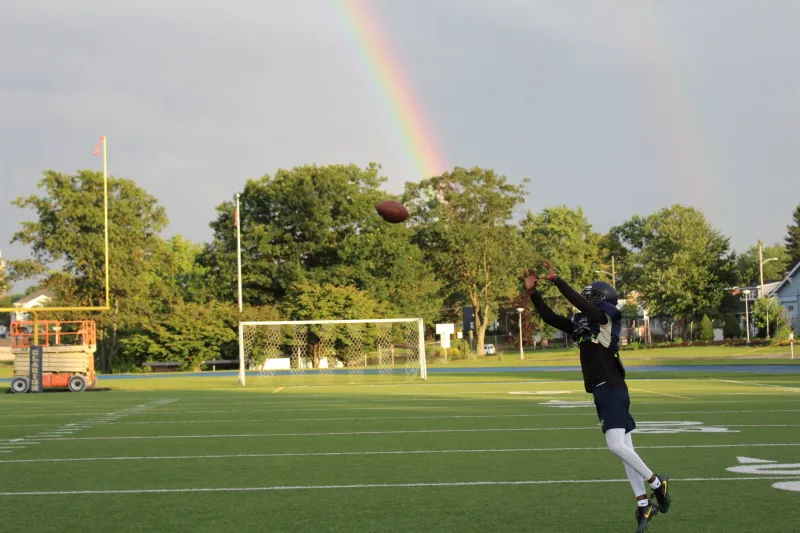
The second major exposure point is catching mechanics under professional throw velocity. College quarterbacks with elite arms exist, but they are exceptions. The majority of college flankers develop catch mechanics calibrated to a range of arm talent that rarely tests the outer limits of hand placement discipline.
Professional quarterbacks deliver the ball with consistent, elite velocity at angles and windows that demand precise hand positioning before the ball arrives. A receiver who has spent four years catching with soft, reactive hands—palms arriving late and adjusting to the ball's final trajectory—will find that professional throws do not wait for that adjustment. The ball is already past the adjustment window.
What this exposes is a fundamental gap in hand mechanics training. Effective professional-level receiving requires pre-positioned hands: knowing, based on route depth, coverage alignment, and quarterback release angle, exactly where the hands must be before the ball enters the catching zone. Receivers who arrive without this skill set experience a specific and demoralizing phenomenon—they drop balls they should catch, not because they lack athleticism, but because their mechanics were never stress-tested at the velocity they are now facing every single day.
Development programs that want to genuinely prepare flankers for this transition must incorporate high-velocity machine training and quarterback simulations that exceed what most college athletes encounter, creating mechanical habits that hold under conditions beyond what the college game demands.
Coverage Recognition at Professional Speed
Perhaps the most quietly devastating transition challenge involves coverage recognition. College defensive backs telegraph their intentions. Alignment tendencies, pre-snap rotation patterns, and leverage choices at the college level are frequently readable in ways that give receivers a significant advantage even before the snap.
Professional secondaries are coached specifically to disguise those same indicators. A college flanker who has built an entire pre-snap reading system on leverage tells and safety depth will arrive in a professional environment where those tells are manufactured deceptions. The cornerback showing outside leverage before the snap may rotate to inside technique at the line. The safety walking down may be a coverage disguise designed to bait a specific route concept.
The receivers who survive this adjustment are the ones who have trained to read coverage from the route itself—using the defender's movement after the snap, not before it, as the primary decision input. This requires a fundamentally different cognitive framework than what most college development programs install. It means building recognition habits that are triggered by post-snap cues rather than pre-snap alignment reads.
Coaches and programs that want to close this gap must design practice environments that deliberately confuse pre-snap reads while rewarding post-snap processing. If every college practice rep allows a receiver to correctly predict coverage before the ball is snapped, the athlete is being trained for a game that does not exist at the next level.
The False Confidence Trap
The most dangerous aspect of the college-to-professional transition is not the gap itself. It is the false confidence that elite college production creates in athletes and, frankly, in the programs that developed them.
A receiver who catches eighty passes in a college season has evidence, powerful and statistically documented evidence, that what he is doing works. That evidence is real. It simply does not transfer. The sample set was collected against a competition level that could not fully punish the habits embedded in the performance. The statistics reflect genuine athleticism and genuine effort applied within a system that could not expose the structural flaws.
Programs that genuinely prepare flankers for the professional leap must build a culture of intentional adversity—designing practice environments that are harder than the competition they are preparing for, not simply reflective of it. That means coverage defenders who are coached to disguise and punish, throw machines calibrated beyond game velocity, and route discipline standards tighter than any college coordinator would demand.
The goal is not to undermine an athlete's confidence. It is to ensure that confidence is built on a foundation that will hold when the competition level rises and the margin for error disappears entirely.
Building for the Next Level Before You Get There
The flankers who make the professional transition successfully share a common characteristic: they were trained, before they arrived, in environments that demanded more than the college game required. Their route precision was held to standards their college coordinators did not enforce. Their hand mechanics were tested against velocities their college quarterbacks could not generate. Their coverage recognition was built on post-snap processing, not pre-snap guesswork.
That kind of preparation does not happen by accident. It requires a deliberate decision, made long before the professional opportunity arrives, to train beyond the immediate competitive environment. The athletes who make that choice early are the ones who arrive at the next level not as projects, but as professionals.