The Voice That Moves Defenses: How Flankers Build the Communication Authority That Wins Critical Moments
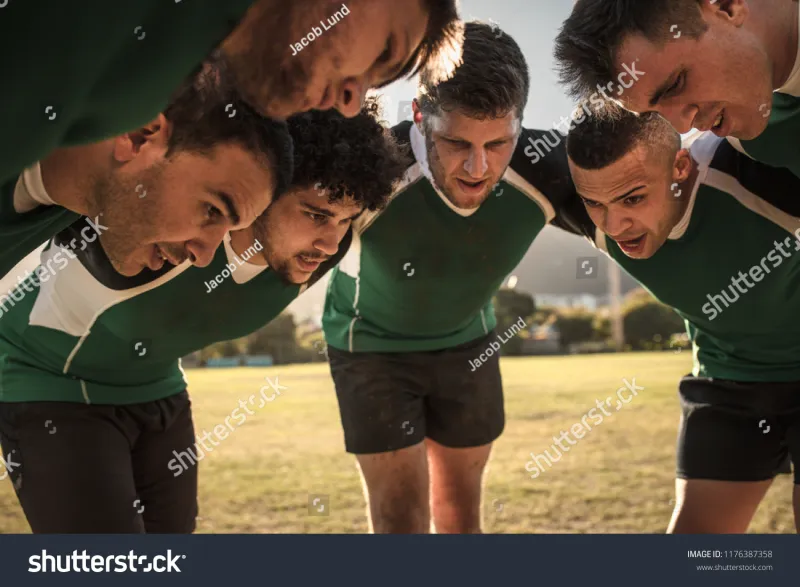
Photo: rugby players defensive huddle communication on field, via www.shutterstock.com
In the final minutes of a close match, when the crowd noise peaks and the defensive structure is under maximum pressure, the athletes who can communicate clearly and with authority become disproportionately valuable. For flankers—who occupy a central defensive role and frequently serve as the connective tissue between the forward pack and the backline—the ability to lead through voice is not a supplementary skill. It is a tactical weapon.
Yet most development programs spend thousands of hours refining physical and technical attributes while dedicating almost no structured time to the communication behaviors that separate good defenders from elite ones. The result is athletes who understand defensive systems intellectually but struggle to transmit that understanding to teammates in real time, under pressure, when it matters most.
Why the Flanker Position Demands Vocal Leadership
The geometry of the flanker's positioning on the field makes verbal leadership a functional necessity rather than a stylistic preference. Operating at the edge of the breakdown and across the defensive line, a flanker possesses one of the broadest sightlines of any forward on the field. That vantage point creates both an opportunity and a responsibility: the information the flanker processes must be shared rapidly and accurately with teammates who may not have the same view.
Consider pre-defensive alignment. A flanker who reads the offensive formation early and communicates the relevant adjustment to the defensive line—before the ball is in play—compresses the reaction window required of every other defender. That single act of communication converts individual tactical awareness into collective defensive efficiency. Multiply it across dozens of possessions in a match, and the cumulative impact on defensive coherence becomes substantial.
The Psychology of On-Field Authority
Communication on a rugby field is not simply about transmitting information. It is about transmitting information in a way that teammates trust, process quickly, and act upon. That distinction is critical, because the loudest voice on the field is not always the most influential one.
Research in team performance psychology consistently identifies two factors that determine whether directive communication is received and acted upon: perceived competence and relational trust. Teammates respond to the athlete whose calls have proven accurate over time and whose presence signals genuine understanding of the game situation—not simply the athlete who shouts the most frequently.
This has a direct implication for flanker development. Building communication authority is a long-term process that begins in practice, not in matches. Every time a flanker identifies a defensive adjustment correctly in a training session and communicates it clearly, that behavior deposits into a relational account with teammates. By the time high-stakes match situations arise, the authority to lead verbally has already been established.
Practical Communication Frameworks for Defensive Leadership
Pre-Snap Calling
The most immediately actionable communication skill for flankers is the development of a consistent pre-snap calling system. This involves reading the offensive formation as it develops, identifying the most relevant defensive implication, and delivering a concise, standardized call that teammates can process without cognitive overload.
Effective pre-snap calls share three characteristics: they are brief, they are specific, and they are delivered with sufficient lead time for teammates to adjust. A call that identifies the anticipated point of attack and the corresponding defensive alignment adjustment—delivered clearly and early—is exponentially more useful than a vague directive issued at the last moment.
Coaches can develop this skill through structured recognition drills in which flankers are required to verbalize their read before the play begins. Over time, this transforms silent internal processing into habitual external communication.
In-Play Adjustments
Communication during live play operates under different constraints. The athlete has less time, more competing sensory inputs, and must execute physically while simultaneously processing and transmitting information. For this reason, in-play communication systems should be reduced to their simplest functional form.
Short, directive calls—positional warnings, gap identifications, pursuit angle corrections—are far more effective than complex instructions mid-play. Flankers who develop a personal vocabulary of high-utility calls and practice deploying them automatically under physical stress will find their in-play communication becoming more consistent and more trusted over time.
Post-Contact Reset Communication
One of the most overlooked communication windows in defensive play is the brief period immediately following a tackle or breakdown. As players realign for the next phase, the flanker has an opportunity to quickly reset the defensive structure verbally before the offense is ready to play again. Developing the habit of communicating during this window—even when physically fatigued—is a distinguishing characteristic of elite defensive leaders.
Delivering Feedback That Teammates Actually Absorb
Leadership communication extends beyond directing traffic in real time. It also includes the interpersonal exchanges that occur between plays, at halftime, and during training sessions. How a flanker delivers feedback to teammates in those moments has a direct effect on whether that feedback influences behavior or generates resentment.
The most durable on-field feedback is specific, forward-looking, and delivered without condescension. Identifying what occurred, explaining the defensive consequence, and offering a concrete adjustment is far more effective than expressions of frustration or generic encouragement. Athletes respond to clarity. They disengage from ambiguity and emotion.
Flankers who develop this skill create a communication culture within the defensive unit that raises the collective standard. Over time, that culture becomes self-reinforcing: teammates begin offering each other the same quality of feedback, and the entire unit's tactical communication improves.
Building Vocal Intensity That Sustains Under Pressure
One of the most common communication failures among developing flankers is the tendency for vocal intensity to drop precisely when it is most needed—late in matches, during sustained defensive sequences, or in high-pressure situations where the natural instinct is to conserve energy and focus inward.
Training vocal intensity under physical stress requires intentional practice. Conditioning sessions that require athletes to communicate defensive calls while fatigued build the habit of maintaining vocal presence regardless of physical state. This is not a minor detail. A defensive unit that communicates clearly in the first half but goes silent under fourth-quarter pressure is a unit that becomes increasingly vulnerable as the match progresses.
The Standard That Separates Good From Elite
The flankers who consistently perform at the highest competitive levels share a common characteristic that statistics rarely capture: they make the athletes around them better through the quality of their communication. They process information quickly, transmit it clearly, and have built sufficient relational trust that teammates respond to their calls without hesitation.
Developing that standard requires deliberate practice, structured feedback, and a long-term commitment to communication as a core athletic skill—not an afterthought. For flankers willing to invest in that development, the return is a form of influence that extends well beyond individual performance and reshapes what an entire defense is capable of achieving.