Unlock Your Lateral Power: 5 Progression-Based Mobility Drills for Explosive Side-to-Side Movement
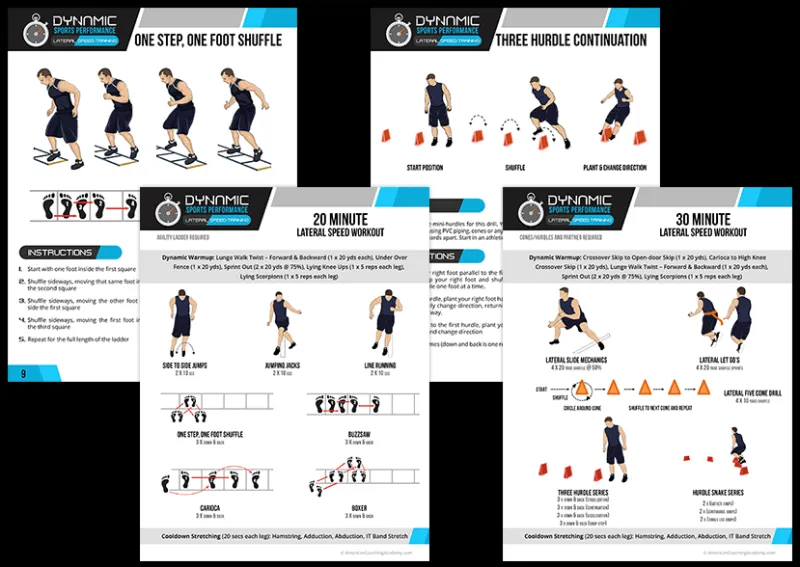
Photo: athlete lateral agility drill hip mobility training speed workout, via americancoachingacademy.com
Ask any competitive athlete what separates a serviceable player from a dynamic one, and the answer almost always circles back to quickness — specifically, the ability to change direction laterally with speed, precision, and force. Whether you are a wide receiver breaking on a route, a defensive back mirroring a ball carrier, or a midfielder tracking a cross-field run, lateral movement is the currency of athletic performance.
The problem is that most training programs address lateral speed through agility drills alone, without first building the mobility and neuromuscular foundation those drills require. The result is an athlete who moves laterally with compensatory patterns — tight hips, collapsed ankles, and stiff thoracic rotation — that cap their speed and increase their injury risk simultaneously.
The five drills outlined below are designed to correct that foundation before building on top of it. Each targets a specific anatomical link in the lateral movement chain, and each includes progressions for athletes at different stages of development.
Drill 1: 90/90 Hip Switch with Lateral Load
Target: Hip internal and external rotation, adductor flexibility
Why It Matters: The hip joint is the primary engine of lateral movement. When internal or external rotation is restricted, the body compensates by overloading the knee and lower back — a pattern that limits speed and invites injury. The 90/90 position addresses both rotation vectors simultaneously.
How to Perform It: Begin seated on the floor with both knees bent at 90-degree angles — one leg externally rotated in front, one internally rotated behind. Sit tall with a neutral spine. Slowly shift your weight toward the front knee, applying gentle load through the hip joint. Hold for three seconds, return to center, then rotate to switch legs. Complete eight to ten full switches per set.
Progression: Once the basic switch feels fluid, add a lateral torso reach in the direction of the front knee as you load into the position. This integrates thoracic rotation with hip mobility, more closely mimicking the demands of a lateral cut.
Beginner Modification: Place your hands behind you for support and reduce the depth of the weight shift until hip flexibility improves.
Drill 2: Lateral Lunge with Ankle Dorsiflexion Emphasis
Target: Groin flexibility, glute activation, ankle mobility
Why It Matters: A lateral lunge that collapses inward at the knee or lifts the heel off the ground indicates a dorsiflexion restriction — one of the most common limiters of lateral acceleration in competitive athletes. Addressing both the hip and the ankle in the same movement pattern creates efficiency.
How to Perform It: Stand with feet hip-width apart. Step laterally with one foot to approximately twice shoulder width, pushing the hips back and down as the knee tracks over the second and third toes. Drive the heel firmly into the ground and allow the ankle to flex forward toward the shin. Hold the bottom position for two seconds before driving back to the starting stance. Perform six to eight repetitions per side.
Progression: Add a dumbbell goblet hold at chest height to increase demand on the posterior chain and core stabilizers, which must work harder to maintain an upright torso under load.
Sport-Specific Application: Football and lacrosse athletes should perform this drill in their sport-specific footwear to replicate the surface and cleat interface they encounter during competition.
Drill 3: Banded Lateral Monster Walk
Target: Gluteus medius activation, hip abductor strength, neuromuscular coordination
Why It Matters: The gluteus medius is the primary stabilizer of the pelvis during single-leg loading — which is exactly what occurs during every lateral step. Weakness in this muscle leads to hip drop, knee valgus, and reduced force production during direction changes. The banded monster walk isolates and activates this often-undertrained structure.
How to Perform It: Place a resistance band just above the knees. Assume a quarter-squat athletic stance with feet hip-width apart. Step laterally in one direction for ten to twelve steps, maintaining constant tension on the band and keeping the torso upright. Do not allow the feet to come together between steps. Return in the opposite direction for the same number of steps.
Progression: Increase band resistance, or transition to an ankle-positioned band for greater mechanical challenge. Advanced athletes can perform this drill in a deeper squat position to increase glute medius demand.
Beginner Modification: Begin with a light band and a narrower step width, focusing on maintaining upright posture and avoiding lateral trunk sway before increasing load or range.
Drill 4: Lateral Bound with Stabilization Hold
Target: Explosive hip abduction, single-leg landing mechanics, ankle stability under dynamic load
Why It Matters: Mobility and activation work are preparatory. At some point, the athlete must express those qualities under velocity. The lateral bound introduces a plyometric stimulus while the stabilization hold reinforces proprioceptive control — training the nervous system to absorb and redirect force efficiently.
How to Perform It: From an athletic stance, push off the inside edge of one foot and drive laterally through space, landing softly on the opposite foot. Upon landing, hold the single-leg position for two full seconds before returning. Focus on a quiet, controlled landing with the hip, knee, and ankle stacked vertically. Perform five to six bounds per side.
Progression: Increase the distance of the bound progressively across weeks. Once landing mechanics are consistent, reduce the hold time and transition to continuous bounding to develop rhythm and rate of force development.
Sport-Specific Application: Basketball and soccer athletes should incorporate a reactive element — landing and immediately responding to a directional cue from a coach or partner — to simulate game-speed decision-making.
Drill 5: Lateral Shuffle to Crossover Cut
Target: Neuromuscular coordination, hip flexor activation, change-of-direction mechanics
Why It Matters: The final drill in this sequence integrates all of the qualities developed in the preceding exercises — hip mobility, ankle stability, glute activation, and single-leg power — into a sport-relevant movement pattern. The crossover cut is one of the most mechanically demanding actions in competitive sport, and training it deliberately accelerates transfer to game performance.
How to Perform It: Begin in an athletic stance at one end of a marked five-yard lane. Perform three lateral shuffle steps, then execute a sharp crossover cut by driving the outside foot across the body and accelerating in the new direction for five yards. Walk back to the start and repeat. Perform four to six repetitions per direction.
Progression: Add a visual or auditory cue to trigger the cut, removing the predictability of the movement and demanding a reactive response. This elevates the drill from a motor pattern exercise to a true neuromuscular training stimulus.
Programming These Drills Effectively
These five drills are most effective when sequenced in the order presented — moving from passive mobility through activation, then into plyometric expression and integrated movement. Performed as a warm-up protocol two to three times per week, athletes typically report noticeable improvements in lateral comfort and quickness within three to four weeks of consistent application.
For competitive athletes preparing for a season, incorporating this sequence into the early phases of a periodized training block will establish the movement quality foundation that agility and speed work can then build upon. Mobility is not a luxury for elite athletes. It is the prerequisite for everything else.