Beyond the Box Score: Redefining What Makes a Flanker Truly Productive
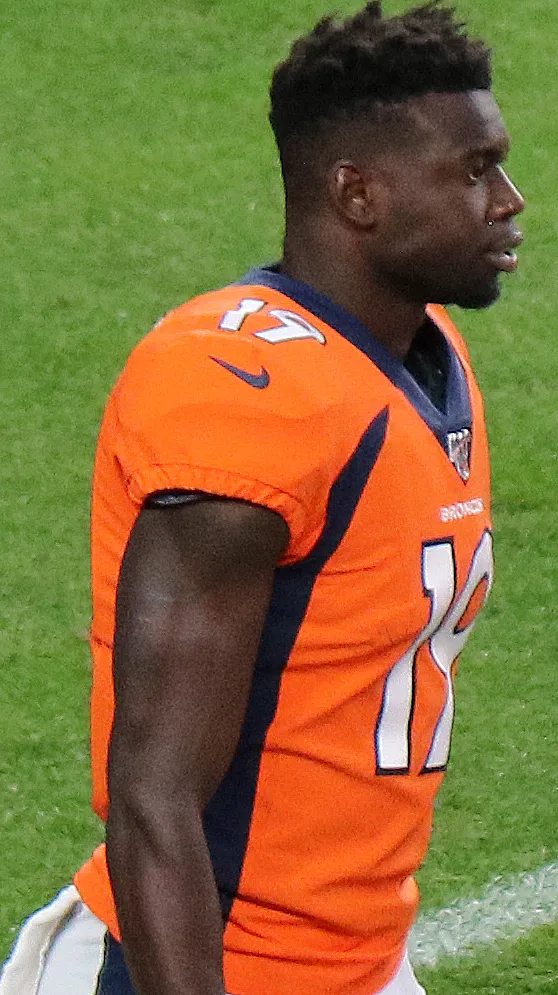
Photo: Jeffrey Beall, CC BY 4.0, via Wikimedia Commons
Every season, the same conversation plays out in film rooms and coaching offices across the country. A flanker leads the unit in receptions. His catch rate sits above 75 percent. By conventional standards, he is the most productive receiver on the roster. Yet the offense stalls in critical moments, third downs feel unmanageable, and the coaching staff quietly acknowledges that something in the evaluation is off.
The problem is not the athlete. The problem is the metric.
Traditional catch percentage—targets converted into receptions—has dominated receiver evaluation for decades. It is clean, easy to calculate, and immediately understood. It is also dangerously incomplete as a measure of competitive impact. For athletes and coaches committed to genuine athletic development, accepting catch rate as a primary performance indicator is the equivalent of measuring a sprinter's effectiveness solely by how often he finishes his lane without stepping out of bounds. Technically relevant. Practically insufficient.
The Illusion of the High-Percentage Receiver
Consider two flankers on the same depth chart. Receiver A catches 18 of 22 targets for a catch rate just above 81 percent. Receiver B catches 14 of 24 targets, sitting closer to 58 percent. On the surface, Receiver A appears to be the more reliable option. Coaches who rely on box-score analysis will deploy him in critical situations and protect Receiver B's role.
But look deeper. Receiver A's targets are concentrated on short routes—quick outs, slants under the linebackers, and screen passes where the quarterback has already made his decision before the snap. His yards per reception hover around 6.2. He generates minimal separation on intermediate routes and has rarely been asked to work against press coverage. His high catch rate reflects a system designed to protect him from difficult assignments.
Receiver B, by contrast, is consistently targeted on contested vertical routes, post corners against single-high coverage, and option routes that demand real-time decision-making from both the quarterback and the receiver. His lower catch rate is not a product of unreliability. It is a product of difficulty. And within those 14 completions, his yards after contact average exceeds 4.8, meaning defenders consistently fail to bring him down at the point of reception.
This is the catch-rate paradox. The metric rewards route accessibility, not route excellence.
Separation Rate as a More Honest Standard
Separation rate—measured as the average distance between a receiver and his nearest defender at the moment the ball arrives—offers a more honest evaluation of a flanker's athletic contribution. A receiver who consistently creates three or more yards of separation on intermediate routes is generating genuine offensive leverage, regardless of whether the quarterback targets him.
This matters enormously for athlete self-evaluation. Competitive flankers who train seriously at the college or semi-professional level often internalize their target share as a reflection of their quality. When that target share drops, confidence erodes. But separation rate decouples a receiver's effectiveness from a quarterback's decision-making. A flanker who creates clean windows repeatedly—even when the ball goes elsewhere—is performing at a high level. That data should inform both practice design and personal development goals.
Athletes looking to audit their own separation rate can begin with film review, tracking the distance between themselves and their defender at ball arrival across a minimum of 15 plays per game. Patterns will emerge quickly. If separation consistently appears on short routes but collapses on anything beyond 12 yards, the development priority becomes clear: intermediate route technique and release refinement deserve more practice volume.
Yards After Contact and the Dimension Most Coaches Undervalue
Yards after contact (YAC) is frequently discussed in the context of running backs, but its application to wide receiver evaluation is equally significant and far less systematically applied. A flanker who consistently generates 3.5 or more yards after initial contact is functioning as an extension of the ground game, converting broken plays into positive gains and keeping drives alive in situations where the scheme has broken down.
This skill set is not accidental. It is trained. Competitive athletes who prioritize balance work, hip-sink mechanics, and contact anticipation in their development programs demonstrate measurably better YAC numbers than those who treat post-catch movement as an afterthought. Balance boards, resisted lateral movement drills, and low pad-level running mechanics all contribute to the physical foundation that makes a receiver difficult to bring down after the catch.
For coaches building evaluation frameworks, weighting YAC alongside catch rate creates a more complete receiver profile. A flanker with a 62 percent catch rate and 4.2 YAC average is frequently more valuable in a competitive system than one with an 80 percent catch rate and 1.8 YAC average—particularly in offenses that depend on chunk plays and run-after-catch designs.
Decision-Making Efficiency: The Variable That Separates Good from Elite
The most underexamined performance variable in flanker evaluation is decision-making efficiency—the rate at which a receiver makes the correct choice during option routes, broken coverage situations, and pre-snap adjustments. This metric is difficult to quantify precisely, but its impact on offensive production is enormous.
Elite flankers do not simply run their assignments. They read the field in real time, adjusting route depth and direction based on coverage rotation, linebacker drops, and safety positioning. A receiver who correctly adjusts a crossing route against zone coverage into a sit route in the open window is demonstrating decision-making efficiency that no catch percentage formula can capture.
Athletes can develop this skill through deliberate film study combined with practice scenarios that present multiple coverage looks before the snap. Walking through defensive alignment recognition—identifying single-high versus two-high safety looks, pattern-matching zone schemes, and man-coverage tells—builds the cognitive processing speed that makes in-play adjustments automatic rather than reactive.
Building a Personal Evaluation Framework
For competitive flankers serious about understanding their true impact, a practical self-evaluation framework should incorporate the following:
- Separation rate: Tracked by film review across a minimum 15-play sample per competition
- Yards after contact: Logged per reception with attention to contact type (open field versus contested)
- Decision-making accuracy: Reviewed in film sessions, noting correct versus incorrect route adjustments on option and check-release concepts
- Contested catch percentage: Isolated separately from total catch rate to distinguish difficulty-adjusted performance
- Route efficiency: Measuring how often correct technique produces the intended separation result, independent of target outcome
This framework does not replace traditional statistics. It contextualizes them. A flanker who understands his own performance at this level of specificity carries a significant developmental advantage over one who waits for a coaching staff to define his value through conventional metrics.
The Competitive Advantage of Honest Self-Assessment
The athletes who develop most rapidly at the competitive level are rarely those with the most raw physical tools. They are the ones who evaluate themselves with precision, identify genuine deficiencies without ego interference, and direct their training energy toward the variables that most directly influence their impact on the field.
Catch rate will remain a convenient shorthand in broadcast booths and casual conversations. But for the competitive flanker committed to genuine development, the box score is a starting point—not a destination. The real performance story lives in the metrics that demand closer attention, deeper film work, and a willingness to challenge the conventional wisdom that has shaped receiver evaluation for far too long.