Own the Ball: How Elite Flankers Take Responsibility for Every Catch, Regardless of Quarterback Precision
There is a quiet assumption embedded in how most receivers are coached, one that limits their ceiling far more than any physical shortcoming ever could. That assumption is this: the quarterback delivers the ball, and the receiver's job is to be in the right place when it arrives. Clean. Simple. And fundamentally incomplete.
Elite flankers operate from an entirely different premise. Rather than positioning themselves as passive endpoints in the passing game, they function as active co-architects of every catch opportunity. The distinction sounds philosophical, but its practical consequences are measurable, immediate, and decisive at the competitive level.
The Myth of the Ideal Catch Window
Every receiver, at some point in their development, is taught to trust the window. The concept is straightforward: run the route correctly, arrive at the designated spot at the designated time, and the quarterback will place the ball where it needs to be. Execution on both ends equals a completion.
The problem is that this model describes a controlled environment, not a football game. At the competitive level, defensive backs contest spacing, pass rushers collapse pockets, and quarterbacks release under duress. The ideal window — that precise intersection of ball trajectory, body position, and timing — exists far less frequently than the playbook suggests.
Athletes who have been conditioned to wait for that window do exactly that: they wait. And waiting, in high-speed, high-pressure situations, is a form of passivity that defenses are specifically designed to exploit.
Active Manipulation Versus Passive Reception
What separates elite flankers from competent receivers is not, in most cases, raw speed or hand size. It is the capacity to manipulate the conditions of the catch in real time.
This manipulation operates on two levels: spatial and temporal.
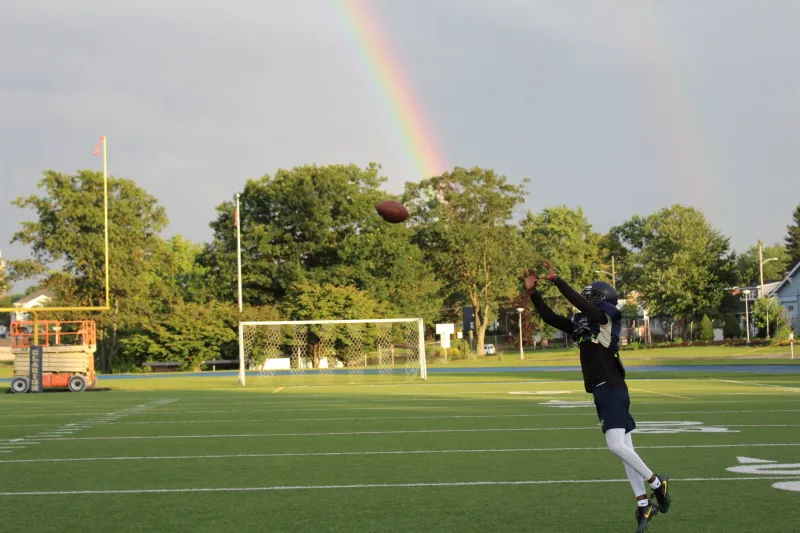
Spatially, elite receivers use body positioning to shrink the effective distance between themselves and a ball thrown slightly outside the ideal window. This involves shoulder rotation, hip drop, arm extension sequencing, and weight transfer — all executed within fractions of a second — to bring the body into alignment with the ball's actual trajectory rather than its intended one. The receiver does not go where the ball was supposed to go. The receiver goes where the ball is going.
Temporally, elite flankers make micro-adjustments to their route timing — subtle elongations or compressions of their final steps — that allow them to arrive at the catch point in a body position that accommodates variance in delivery. This is not improvisation. It is trained adaptability, built through deliberate repetition of off-target catch scenarios that most practice environments never replicate.
Why Standard Practice Environments Fail Receivers
Most receiver training programs optimize for accuracy. Quarterbacks throw clean, catchable balls. Routes are run at controlled speeds. Defenders, when present at all, are limited in their physicality. The result is a receiver who becomes extraordinarily proficient at catching well-thrown passes — and increasingly fragile when the throw is anything less.
This is a structural problem, not a talent problem. When athletes are consistently rewarded for waiting in the right spot, their nervous systems encode passivity as the correct response. When a pass arrives high, wide, or behind the break point, the receiver's trained instinct is to recognize the error rather than solve it.
Developing the opposite instinct — the instinct to solve — requires deliberate exposure to imperfect conditions. This means incorporating off-target throws into receiving drills systematically, not as occasional aberrations but as the primary training stimulus. It means creating practice scenarios where the receiver knows the ball will not be ideal and must develop the physical and cognitive habit of adjusting to it.
Biomechanical Foundations of Catch Adaptability
The physical capacity to adjust to off-target throws is not accidental. It is the product of specific biomechanical attributes that can be trained.
Hand independence — the ability to position each hand separately in response to a ball's actual arrival point rather than its anticipated one — is perhaps the most critical. Many receivers catch with their hands moving as a unit, which works perfectly for balls thrown into the body's midline. Balls thrown to the left shoulder, the right hip, or above the helmet require each hand to travel a different distance along a different plane. Training this independence through asymmetric catch drills builds the neural pathways that make contested catches possible.
Core rotational strength plays an equally important role. Adjusting to a ball thrown behind the break point often requires the receiver to decelerate, redirect their torso, and extend their arms across their body — all while maintaining balance against potential contact. The strength demands of this movement are significant, and athletes who lack rotational power in their core will consistently fail these adjustments at game speed, regardless of their hand-eye coordination.
Finally, visual tracking under physical stress — the ability to maintain focus on the ball while the body is moving, adjusting, and potentially absorbing contact — is a trainable skill that is almost universally undertrained. Catch-point drills that incorporate physical disruption, whether from a defender's hand fighting or the athlete's own movement-induced instability, accelerate the development of this capacity considerably.
Reframing Accountability in the Passing Game
Shifting a flanker's mindset from passive reception to active ownership does not diminish the quarterback's role. It expands the receiver's. The two are not in competition.
When a flanker internalizes the belief that every catchable ball — not just every perfectly thrown ball — is their responsibility, their range of effectiveness expands dramatically. Quarterbacks gain confidence throwing into tighter windows because they trust their receiver to accommodate slight variance. Offensive coordinators gain flexibility designing routes because the completion probability on each throw increases even when execution is imperfect.
This is not a theoretical benefit. It is the operational reality of how elite passing offenses at every level — from major college programs to the NFL — actually function. The receivers who stay on the field in critical moments are not necessarily the ones who run the cleanest routes. They are the ones who make the quarterback right even when the throw was not.
Building the Habit at the Practice Level
Translating this philosophy into a training program requires intentionality. A few structural changes to standard receiver practice can accelerate development significantly.
First, introduce deliberate inaccuracy into catch drills. Have quarterbacks or coaches throw to specific off-target zones — high and outside, low and inside, behind the break — and evaluate the receiver not on whether the throw was catchable in theory, but on whether they made it catchable in practice.
Second, film these adjustments and review them with the athlete. Visual feedback on the specific moments where the body failed to adapt — where the hands moved too slowly, where the hips did not open, where the eyes came off the ball — accelerates the correction process in ways that verbal coaching alone cannot.
Third, reward successful adjustments explicitly. Athletes develop the habits that their environment reinforces. If the only catches that earn recognition are the clean ones, the culture of passive reception deepens. When adjusted catches are treated as a skill worth celebrating, athletes begin competing to make them.
The catch window is not a fixed target. It is a negotiation. And the flankers who understand that — who train for it, compete through it, and own every ball within their reach — are the ones who define what elite receiving actually looks like.