Play to Your Wiring: How Natural Handedness Builds Route Specialists Defenses Cannot Neutralize
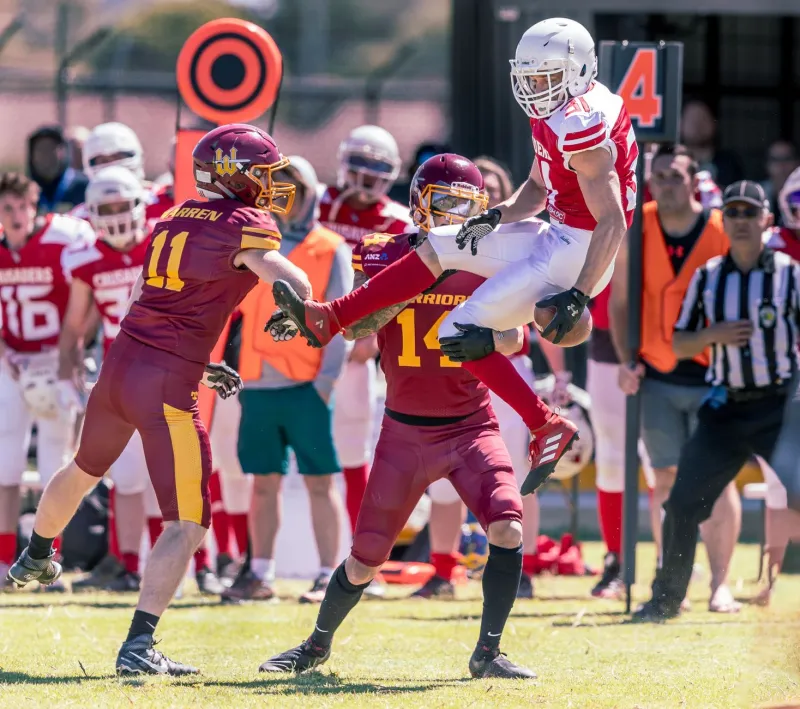
For years, conventional coaching wisdom has nudged wide receivers toward balance — work the off-hand, catch equally well from both sides, become a complete player. The instinct is understandable. Coaches want versatility. Coordinators want options. But at the elite level of competitive football, that pursuit of symmetry may be quietly undermining the very attribute that makes a flanker truly dangerous: a deeply ingrained, neurologically dominant skill set that a defender simply cannot account for.
The asymmetrical advantage is real. And for competitive flankers who understand how to harness it, handedness is not a limitation to correct. It is a weapon to deploy.
The Neuroscience of Dominant-Side Superiority
Handedness is not merely a preference — it is a reflection of how the brain organizes motor control. The dominant hemisphere governs the preferred hand with a level of precision, speed, and fine-motor coordination that the non-dominant side cannot replicate through conventional training volume alone. Neuroscientists refer to this as lateralization, and in the context of receiving mechanics, its implications are significant.
When a flanker reaches across his body to secure a ball with his dominant hand — particularly on a back-shoulder fade, a slant away from his alignment side, or a contested catch over the inside shoulder — he is executing a movement pattern that his nervous system has rehearsed thousands of times since childhood. The grip is faster. The squeeze reflex is more reliable under pressure. The proprioceptive feedback loop between fingertips and brain is tighter.
Contrast that with a catch made on the non-dominant side under identical defensive pressure. The mechanics are technically similar, but the neural pathway is less reinforced, the reaction time is marginally slower, and the error rate under duress climbs. In practice, those margins may feel negligible. In a fourth-quarter contested catch with a cornerback draped on your back, they are the difference between a completion and a drive-ending incompletion.
Why the Ambidextrous Ideal Often Backfires
The goal of developing equal proficiency in both hands is not inherently misguided. For a developmental athlete still establishing foundational mechanics, off-hand work builds important neural connections and prevents exploitable weaknesses. But at the competitive level — where a flanker is refining a route tree against sophisticated coverage schemes — the calculus changes.
Time spent attempting to elevate the non-dominant hand toward parity is time not spent deepening the dominant-side mastery that already separates a player from the field. More critically, forcing equal development can introduce hesitation. A receiver who has been coached to distrust his natural catching instincts — who pauses fractionally to think about hand placement rather than reacting — has traded reflexive certainty for manufactured balance.
Elite cornerbacks already operate at the edge of what a receiver's mechanics can handle. Any erosion of automaticity in the catch sequence, however small, creates an opening that experienced defensive backs will find.
Mapping the Route Tree to Dominant-Side Leverage
The strategic application of handedness begins with an honest assessment of where a flanker's dominant side creates the greatest separation advantage — not just in the catch, but throughout the entire route execution.
For a right-handed flanker, routes that finish with the body turned left and the right hand in the primary catch position are biomechanically efficient. The comeback route to the boundary, the back-shoulder throw on a fade route to the right hash, and the crosser that finishes with a rightward lean all position the dominant hand as the primary contact point. The body's natural rotation reinforces the grip rather than fighting it.
More importantly, these routes can be run with a level of physical commitment — a harder plant, a more aggressive lean into the break — that is difficult to replicate on the opposite side. The flanker's confidence in his dominant-side finish allows him to sell the route more convincingly, which is itself a form of separation. Defensive backs read commitment in a receiver's body. A route run with full neurological conviction looks different from one run with manufactured technique.
Building the primary route tree around these dominant-side finishing positions is not about ignoring the rest of the playbook. It is about identifying the six to eight routes where a flanker can operate with elite-level automaticity and making those routes so refined that they become genuinely undefendable against man coverage.
Exploiting Man Coverage Through Positional Asymmetry
Man coverage presents a specific tactical opportunity for the dominant-side specialist. A cornerback aligned in press man must account for a flanker's full route tree. When a receiver has clearly established that his dominant-side routes are executed at a higher level — through film study, through in-game tendencies, through the simple reality of completion percentage — the cornerback faces a coverage dilemma.
If he shades toward the dominant-side leverage point, he opens the weak-side route to the non-dominant hand. If he plays balanced, he concedes the dominant-side route's superior execution. Neither option is comfortable. The flanker has effectively used his asymmetry to create a false choice for the defender.
This is the tactical sophistication that separates route specialists from generic receivers. It is not about running every route in the tree equally well. It is about making specific routes so polished — so deeply grooved in the motor system — that a defender's only option is to concede ground somewhere.
Building the Training Program Around Neurological Strengths
The practical implication for competitive flankers is a deliberate reprioritization of training volume. Dominant-side routes deserve disproportionate repetition. Not because the other routes do not matter, but because mastery — true, reflexive, pressure-proof mastery — requires a level of repetition that cannot be spread equally across an entire route tree.
Coaches working with competitive flankers should identify the three to four routes in which a player's dominant-side mechanics create the clearest biomechanical advantage, then build practice structure around accumulating high-quality repetitions on those specific patterns. Film review should reinforce the same routes, allowing the player to internalize the coverage reads that trigger those dominant-side options.
Off-hand development continues, but it is framed correctly — as a means of preventing exploitation, not as a path to symmetrical excellence. The goal is functional competence on the non-dominant side and elite mastery on the dominant side. That is not a compromise. That is a competitive strategy.
The Specialist Advantage in a Copycat League
American football has always rewarded specialists who do one thing at an extraordinary level. The slot receiver who runs the crossing route better than anyone in the conference. The boundary flanker whose back-shoulder fade is statistically automatic. These are not incomplete players — they are precisely engineered weapons that coordinators build game plans around.
Handedness is the foundation of that specialization. It is the neurological substrate from which a truly undefendable skill set is built. The competitive flanker who understands this — who stops apologizing for his asymmetry and starts exploiting it — has already made a significant step toward the kind of route mastery that earns targets, wins matchups, and defines careers.
Play to your wiring. The defense has no answer for a player who has.